
Outdoor Sauna: What to Decide Before You Buy One
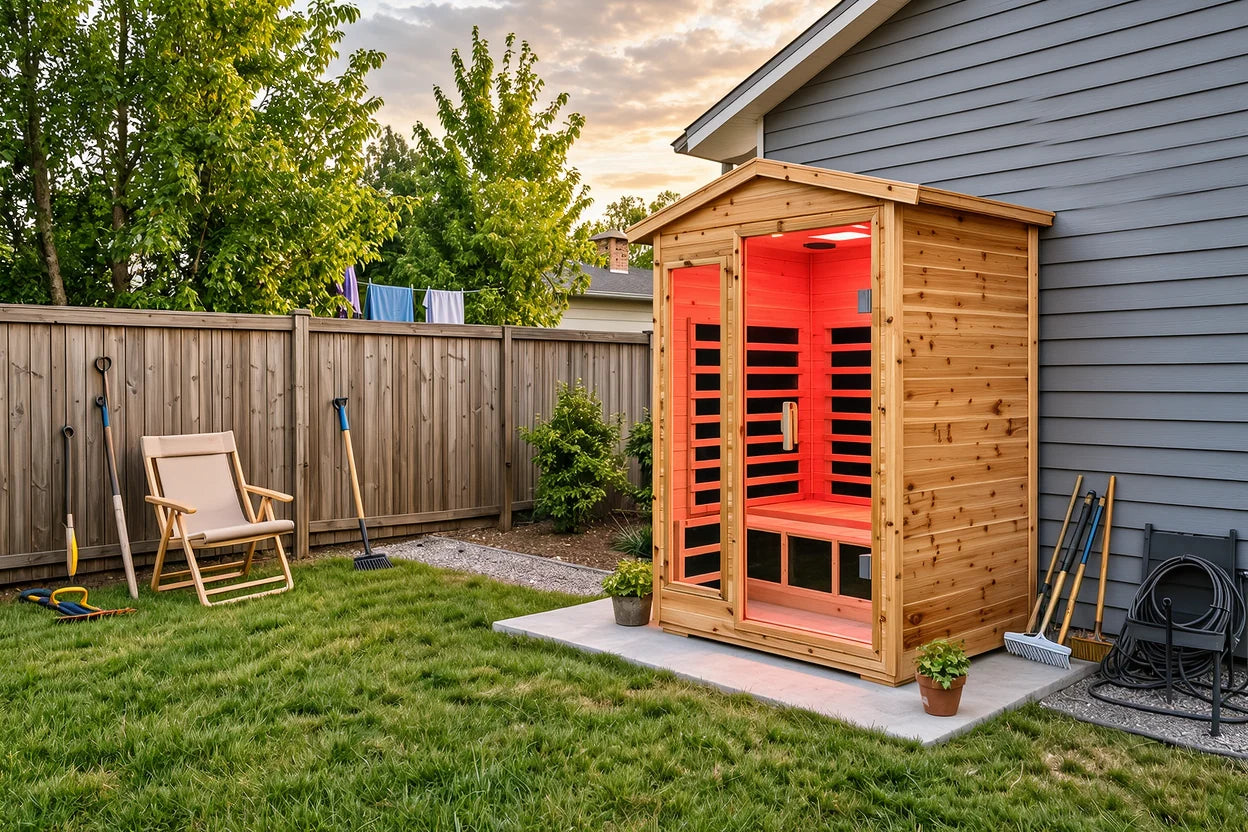
One of our customers, Carol, marked a rectangle on her lawn with spray paint before she called us.
Roughly four feet by five. About where she thought it should go.
Then she stood inside it for a while. Looked at the fence. Looked back at the kitchen window. Went inside and made tea.
Her question, when she finally rang, wasn't about heaters or wood or price.
"How do I know I'm putting it in the right place?"
It's the best question in this whole category, and almost nobody asks it until the pallet is already on the driveway.
The Order Almost Everyone Gets Wrong
Most people start shopping by looking at models. Two person, four person, with red light or without, this brand or that one.
That's the last decision, not the first.
By the time you've picked a cabin, three things have already quietly decided what you can buy: where it goes, what's under it, and how you'll power it.
Get those wrong and the model doesn't matter. Get them right and the shortlist picks itself.
This article walks through them in the order they actually matter. There are four.
The most expensive mistake in this category isn't buying a bad sauna. It's buying a good one that ends up somewhere you won't walk to.
A cabin on the far side of the lawn, down a dark path, gets used twice a week in summer and not at all in February. The same cabin fifteen steps from the back door gets used four times a week for a decade. Same product, different life.
First, One Word Covers Three Different Buildings
Before going further, it's worth separating something, because the same phrase gets used for three things that behave nothing alike.
An infrared cabin. A timber box that plugs into a wall outlet, warms up to about 140°F in twenty minutes, and needs no chimney, no drain and — in most places — no permit. This is what most people are actually shopping for.
A traditional hot room. A stove, a pile of rocks, a bucket of water, 180°F and up. Real steam. It needs ventilation built for it, usually a proper footing, and often a builder.
A barrel. A cylinder on its side. Photographs beautifully, sheds rain well, and has real trade-offs at the door ends and along the benches that the photos never show.
Everything below is about the first one, because that's what we build and what we can speak about honestly.
If the ritual you're picturing involves a ladle and a bucket of water, buy a traditional sauna. We'd rather tell you that now than have you disappointed every evening for a year.
Decision One: The Exact Spot
Not "in the backyard." The specific patch of ground.
Five things decide whether a spot works: the slope, where water drains, how far it is from the house, how far it is from the property line, and what's overhead.
This is the only decision that can't be changed later without help. Everything else can be worked around.
And it's the one people make in a hurry, usually by standing in the yard and pointing.
A simple test before you commit
Walk out your back door at nine at night, in winter clothes, carrying a towel.
Count the steps to the spot. Notice whether the path is lit. Notice whether you'd do it barefoot in the cold, or whether you'd need shoes and a robe and a reason.
If the answer is "I'd probably skip it tonight," that's not the spot.
Fifteen to thirty steps from a back door is the sweet spot. Close enough that going out isn't an expedition, far enough that it isn't in the way.
The single best predictor of whether someone still uses their sauna in year three is how far they have to walk in the dark. Not the heater count. Not the brand.
Decision Two: What's Underneath
Four options, and they're not equal.
A timber deck. Most common, and fine if it was built for the weight. Ask before you assume — a cabin with a full bench, a heater and two adults is considerably heavier than the garden shed that footprint usually holds.
A concrete pad. The most permanent and the most forgiving. Also the hardest to move later.
Compacted gravel. Cheapest, drains well, and works nicely for a cabin that sits low. It needs a proper base under it or it will settle unevenly within a season.
Directly on soil. No. Never. Moisture comes up through it and the base of the cabin is exactly where you don't want water.
Whatever you choose, one rule outranks the others: the ground has to be level, and water has to run away from the cabin rather than toward it.
Water running toward a cabin is a much bigger problem than rain falling on it. Rain lands on a roof designed for it. Water pooling at the base finds the wood.
Decision Three: Power
This is where people get caught on delivery day, so it's worth checking early.
Two-person indoor models draw under fifteen amps. That's a normal household circuit — the same kind a hairdryer and a microwave share. They plug in and they work.
Larger outdoor cabins and four-person models draw more. Check the electrical specification on the product page against your panel before you order, not after.
Running a dedicated circuit isn't a big job for an electrician. It's just a job, and it takes a week to schedule. Better to know in week one than on the morning the truck arrives.
Decision Four: The Enclosure
Roof, glass, insulation, door seal. This is the part that decides whether a cabin survives five winters or starts leaking in year two.
It's also the part nobody compares properly, because it never appears on a feature list.
Two things matter most, and both are easy to check if you know what to ask.
The roof. A pitched roof sheds water in two directions and moves snow off by itself. A flat lid holds both. We went through that in detail in why our outdoor roof is a classic American gable.
The glass. Thickness and tint decide how well it holds heat and how the cabin feels to sit in. That's covered in what glass thickness and tint actually change.
What Changes When It Lives Outside
An outdoor cabin isn't an indoor one with a roof bolted on. Five things are genuinely different.
It works harder to stay warm. Indoors, the cabin sits in a heated room. Outdoors, it's holding heat against cold air all day. Preheat takes longer in January and the running cost is a little higher than the same model indoors.
Water becomes the enemy, not heat. The first thing to fail on an outdoor sauna is the door gasket, not the heater. Water collects in the channel under the glass, the rubber stiffens, and the cabin starts losing heat exactly where you can't see it.
The wood matters more. Cedar and mahogany weather to a soft grey instead of rotting, which is why they're the standard. Cheaper softwood looks fine for two years and then starts telling you the truth. We covered that in what determines how long an outdoor cabin lasts.
Cooling down becomes part of the session. Stepping out into forty-five-degree air after ten minutes of heat is the best part of an outdoor sauna. It's the reason people use them more than indoor ones. We wrote about a full year of that in an outdoor sauna through four seasons.
It becomes part of the property. Owners keep telling us guests assume it came with the house. A cabin that looks like it belongs gets used. A unit that looks like equipment gets dusted and ignored.
The First Year, Honestly
Here's what actually happens, month by month.
Week one. Assembly. For an outdoor cabin that's a half day with two people, not twenty minutes. Then a first session where you're mostly noticing the cabin instead of relaxing in it.
Month one. Heavy use. This part is real — most people use a new sauna five or six times a week at first.
Month three. The honest test. The novelty has worn off, the calendar is full, and the cabin either has a place in your week or it doesn't.
First winter. The learning curve. Preheat takes longer, the door seal gets its first real workout, and you find out whether your siting decision was right.
Year two. Where the money shows. A well-built cabin needs a gasket check and not much else. A cheap one starts showing you where it saved.
What It Costs to Run
An infrared cabin draws about the same as a hairdryer. At typical US rates, a session costs somewhere between twenty and thirty cents.
A traditional hot room heats a much heavier box of air and stone, so it typically costs several times that per session.
Outdoors, add a margin in cold weather. A January session in Minnesota costs more than a June session in California, because the cabin is holding heat against worse conditions. It's still cents we're talking about, not dollars.
The bigger lifetime cost isn't electricity. It's the door gasket, the cover, and the pad. Which is why the siting decisions matter more than the utility bill.
When an Outdoor Sauna Is the Wrong Choice
Four situations where we'd tell you not to buy one, and mean it.
- You rent, and you're not staying five years. An outdoor cabin isn't furniture. It's a structure, and moving it is a project.
- The power isn't there and can't be run. If the panel can't take the load, the cabin becomes a very expensive shed.
- Your HOA or local code won't allow it. Check first. Rules on accessory structures vary enormously by town, and a permit problem isn't something a retailer can solve for you.
- You actually want steam. If the ritual in your head involves a ladle, buy a traditional sauna. We sell infrared because it's what we build well, not because it's the only answer.
If you're still working out whether your yard can take one at all, we covered the practical side in whether you can put an infrared sauna outside.
Then, and Only Then, the Model
Once siting, base and power are settled, choosing a model is genuinely easy, because most of the shortlist has already eliminated itself.
What's left comes down to two things: how many people will really be in it, and how good the enclosure is.
Two adults is the practical size for most households. Three or four only makes sense if you'll actually use it together — a bigger cabin costs more to heat, and it puts the red light panel further from where you sit.
We keep a more detailed comparison in choosing an outdoor infrared sauna for a backyard. This page is the orientation. That one is the shortlist.
The Bottom Line
An outdoor sauna is four things: a spot, a base, a power source, and an enclosure. In that order, every time.
The heaters are the easy part. Every brand has heaters. What separates cabins is where yours sits, what it's standing on, and whether the roof was designed for weather or for a photograph.
Carol, for what it's worth, moved her rectangle six feet closer to the house before she ordered. She told us later it was the best six feet she ever measured.
Frequently Asked Questions
What is an outdoor infrared sauna?
A timber cabin built to sit outside year-round, using far-infrared panels instead of a stove and rocks. It plugs into a normal outlet and reaches about 140°F in twenty to thirty minutes.
Do you need a permit for an outdoor sauna?
Depends on your town and your HOA. Many places exempt small accessory structures; others don't. Ask locally before you order.
Can an outdoor infrared sauna be used in winter?
Yes — winter is when most owners use theirs most. Allow a longer preheat and keep snow cleared from the door.
How much does it cost to run an outdoor sauna?
About twenty to thirty cents a session at typical US rates, with a margin on top in deep cold.
What base does an outdoor sauna need?
Level, drained and load-bearing: a timber deck, a concrete pad, or compacted gravel. Never directly on soil.
How long does assembly take?
A half day with two people for an outdoor cabin. Indoor two-person models take fifteen to thirty minutes.
Does an outdoor sauna need a cover?
Worth having in most climates for leaves and snow. It's extra protection, not a substitute for a proper roof.
How long does an outdoor infrared sauna last?
Well over a decade with basic care. The roof, glazing and door seal decide that — not the heaters.
Can it go on an existing deck?
Often yes, but check the deck's rating first. A loaded cabin is far heavier than patio furniture.
How close to the house should it be?
Fifteen to thirty steps from a back door. Distance is the biggest reason saunas stop being used.
We've been building sauna products since 2004, and the outdoor range is the part of the catalogue we've reworked most: classic American gable roofs, red cedar and mahogany bodies, double-glazed front walls, and red light arrays placed where you can actually sit close enough for them to matter.
Factory-direct, out of Jurupa Valley, California. Two-year warranty on heaters and electrical, one year on the wood, optional extensions. You can see the range at salusheat.com/collections/all-products.
- One to four person outdoor cabins in red cedar and mahogany
- Classic American gable roofs with projecting rake edges
- Double-glazed front walls, for condensation and overnight heat loss
- Tea-tinted and green-tinted tempered glass, thicker than the category standard
- Red light arrays on the facing wall, at a seated distance that delivers a dose
- Two-year warranty on heaters and electrical, one year on the wood, optional extensions
The heaters are the easy part. The enclosure is where the difference lives.
If you're still deciding, what's stopping you: the pad, the power, or the permission? Tell us in the comments.
This article is for informational purposes only. Any outdoor installation should follow the manufacturer's siting, clearance and electrical instructions, and local building or permit requirements where they apply. Heat tolerance varies by individual; consult a physician before sauna use if you manage a cardiovascular condition, are pregnant, or take medication affecting heat response.
