
Can You Put an Infrared Sauna Outside?
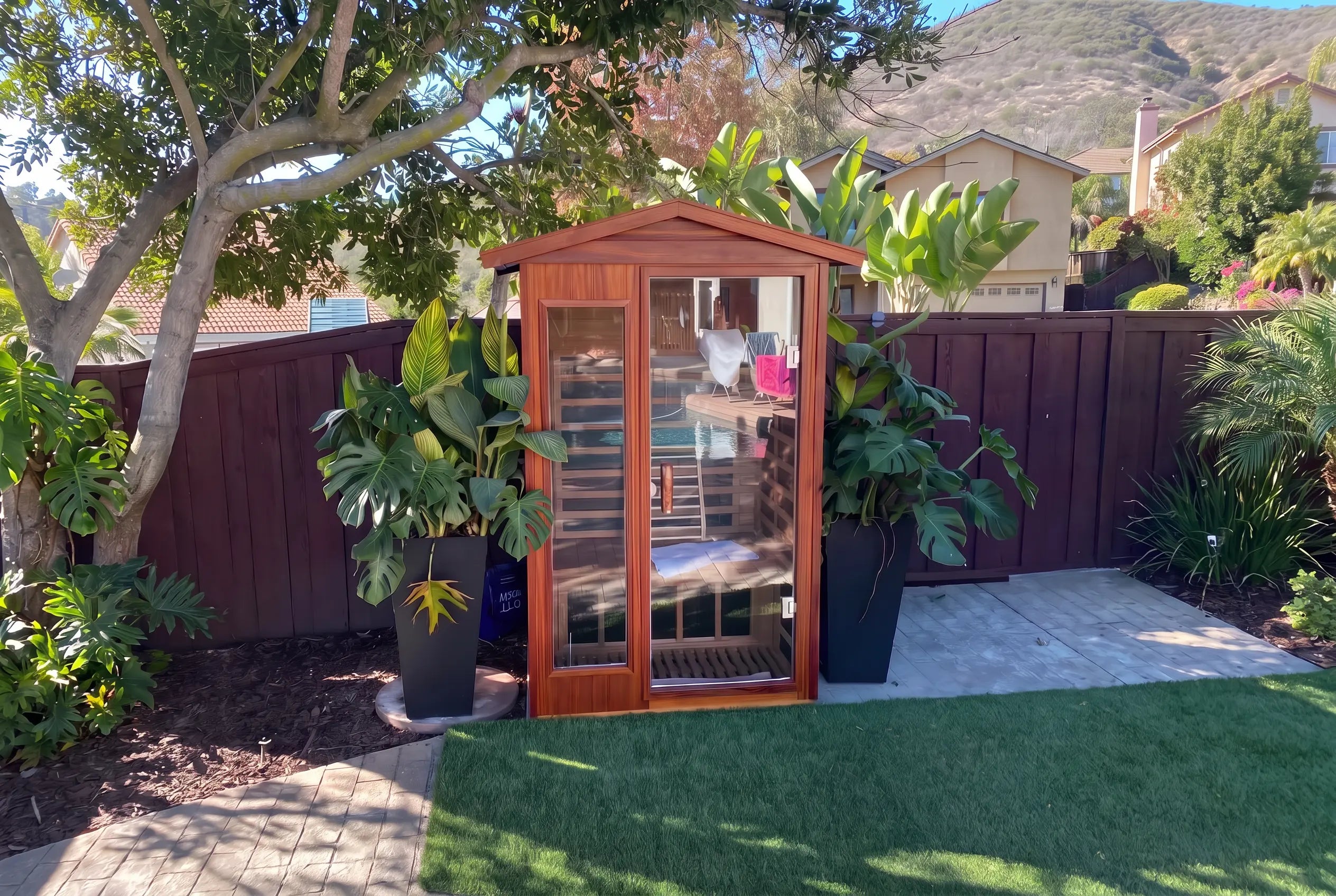
You've been picturing it for a while now.
The sauna, out on the patio, steam rising off your shoulders on a cold evening, no basement renovation, no garage surrendered.
Maybe you've already typed "infrared sauna outdoor" into Google a few times.
Maybe you got as far as the checkout page once and then closed the tab, because a quiet voice asked the obvious question: can it actually live outside?
It's a fair question. And it deserves a longer answer than most brands bother to give.
Here's the short one, plainly: yes, an infrared sauna can live outside year-round — but only if it was built for that life from the beginning.
"Outside" is not one place. It's a humid coastal patio in Florida, a dry sun-baked deck in Arizona, a snow-covered backyard in Minnesota. The wood, the roof, the heaters, and the wiring either match that life or they don't.
An outdoor infrared sauna fails or survives based on four things, in this order: the roof, the wood species, the sealing, and the electrical. Rain and cold are manageable — physics says so, and our own customers prove it every winter.
What ruins outdoor saunas isn't weather. It's buying a cabin that was designed for indoors and hoping the cover makes up the difference.
What Other Brands' Owners Wish Someone Had Told Them
Spend an hour in any sauna owners' group and you'll notice a pattern. The posts aren't from people who hate saunas.
They're from people who love the sauna and are quietly furious at what the sauna is doing to them — or at who's not picking up the phone about it.
Three scenes come up so often they're practically genres.
Scene 1: The heater that was dead on arrival
One owner in a popular sauna community described spending hours on support calls trying to get a brand-new unit working, only to be told the heating panels themselves were defective and would need replacing.
Another buyer put it more bluntly: the difference between a low-EMF panel and a bargain panel is something you don't discover until you're sitting next to it.
The heater is the whole point of an infrared sauna. Everything else — the wood, the glass, the Bluetooth — is supporting cast.
Before you wire anything in, know who's actually standing behind those panels and what happens if one fails in year two.
Scene 2: The budget kit that warped by season two
In a build-focused group, one owner posted photos of their expensive backyard sauna kit with a confession that drew knowing nods from the veterans: "Much of the wood is warped." The blunt consensus from longtime owners in the replies: purchased expensive outdoor kits tend to have a realistic lifespan of about five years — and that's with gentle treatment.
The wood species isn't a design choice. It's the structural decision. Thin, untreated, or unsuited lumber doesn't care how good the marketing photos looked.
Scene 3: The rainwater that got in anyway
Perhaps the most sobering story came from an owner who did everything right on paper — full waterproof cover, careful placement — and opened the door after a heavy storm to find the cabin had taken on water regardless. A cover over a sauna whose roof and seams were never engineered for weather is a tarp over a sieve.
Notice what these three scenes have in common: nobody regretted the idea of an outdoor sauna. They regretted a specific build decision — the heater supplier, the lumber grade, the roof design. Those decisions are visible before you buy, if you know where to look.
The Four Things That Decide Whether Yours Survives
Every outdoor sauna failure traces back to one of these four. We break each down in full technical detail in our guide to what makes an outdoor infrared sauna last year-round, but here's the checklist version to carry with you while you shop:
- The roof. Flat, unsealed roofs let water find every seam. A proper outdoor cabin has a pitched roof that actively sheds rain and snow, with sealed joints you can inspect before assembly.
- The wood. Central African coastal mahogany and Canadian Western red cedar earn their reputations outdoors — naturally resistant to rot, warping, insects, and the dry-crack cycle that destroys lesser lumber. If a listing won't tell you the species and thickness, that's your answer.
- The sealing. Moisture protection at every joint and base plate is what keeps a humid climate from becoming a mold problem inside the walls two summers from now.
- The electrical. Weather-rated components, clean cable routing, and a dedicated outlet with GFCI protection. This is the part nobody photographs for the product page, and the part that matters most on a wet January night.
Before you buy any outdoor sauna, ask the seller two questions directly: What is the EMF reading at seated position? and What exactly does the warranty cover, and who do I call when something fails?
A trustworthy brand answers both in plain numbers. Vague reassurances — "industry-leading," "premium quality" — are not answers. They're decorations.
Will It Actually Get Hot When It's Cold Out?
This is the question underneath all the others, and the answer surprises most first-time owners in the best way. Infrared panels heat you, not the air. Your core temperature rises the same way whether it's 75°F or 35°F beyond the glass. Winter doesn't dilute the session; for many owners, it improves it.
What changes in the cold is the warmup. An outdoor cabin on a frosty morning needs a longer preheat — and that's normal physics, not a flaw.
Notice what's inside that review: the preheat is real, it's manageable, and it becomes part of the ritual rather than a complaint. Turn it on, make coffee, come back to a cabin that's ready.
Many owners tell us the cold-air contrast — stepping out into winter afterward — ends up being the part they look forward to most.
The One We Built for Exactly This Life
Which brings us to the answer we know best, because we designed it for this exact question: the Wearwell-902VT 2-Person Outdoor Infrared Sauna.
The cabin is built from Central African coastal mahogany — a species chosen because it holds its shape against humid, rain-heavy coastal air and long stretches of dry desert heat alike.
That's not a coincidence of sourcing; it's the engineering response to the two climates that kill lesser outdoor saunas. Inside, nine ultra-low EMF far infrared panels provide even, wraparound heat, and the upgraded configuration adds a red light therapy panel for the skin and recovery benefits more owners are asking about every year.
At about 58 inches wide including the roof, it settles onto a standard patio or deck without claiming the whole yard. And because we sell factory-direct, you're not paying a showroom's markup — the difference goes into the lumber and the heaters instead.
| What Owners Check | Budget Kit Reality | Wearwell-902VT |
|---|---|---|
| Wood | Thin, often untreated lumber | Central African coastal mahogany |
| Heaters | Unknown supplier, vague EMF claims | 9 ultra-low EMF far infrared panels |
| Roof | Flat or minimally sealed | Pitched outdoor roof, weather-sealed |
| Extras | Sold separately, if available | Optional red light therapy panel |
| Support | Ticket systems that go quiet | Direct line to the people who build it |
If you're weighing sizes, the Wearwell-901VT 1-person model is the same outdoor build in a smaller footprint, and the outdoor sauna buying guide walks through the full selection logic. Full specs for the 902VT — dimensions, electrical, panels, delivery — are on the product page.
Keeping It Simple for the Next Fifteen Years
The owners whose outdoor saunas still look new in year eight aren't doing maintenance marathons. They made four good decisions on day one — level ground, airflow underneath, a cover for long idle stretches, panels wiped after sweaty sessions — and then repeated those decisions lightly, season after season. Ten minutes a season beats a restoration project in year five.
- Place it on flat, firm, level ground. A concrete pad, pavers, or a sound deck. Bare grass holds moisture against the base — that's how rot starts.
- Leave breathing room underneath. A small air gap lets moisture escape instead of trapping it against the floor panel.
- Cover it during long idle stretches. A breathable cover during vacations or off-season months cuts UV and debris exposure dramatically.
- Run it occasionally in the off-season. Wood and heaters both prefer regular, gentle use to months of cold storage.
- Wipe down after sessions. A quick towel pass on the bench and panels, door left ajar to dry. Two minutes, tops.
The Bottom Line
Can you put an infrared sauna outside? Yes — when the roof sheds water, the wood was born for weather, the heaters are documented rather than decorated, and someone answers the phone in year two. You don't need a renovation. You need four good decisions made once, and a ten-minute habit each season.
Still weighing the heater technology itself? Our explainers on near versus far infrared and full spectrum versus far infrared will keep you from buying the wrong panels. Working with a tighter space? The 1-person infrared sauna guide covers that path.
Frequently Asked Questions
Can an infrared sauna really sit outside in the rain?
Yes, if it's purpose-built for it — pitched sealed roof, weather-resistant wood like mahogany or red cedar, protected electrical. An indoor sauna placed outside without those features is the scenario that fails, usually within a couple of seasons.
Do I need a cover for an outdoor sauna?
Not mandatory for a well-built outdoor cabin, but it's cheap insurance. During long stretches without use, a breathable cover reduces UV exposure and keeps the exterior looking new far longer.
Does an outdoor infrared sauna work in winter?
Better than most expect. Infrared panels heat your body directly, so cold air only adds a few minutes of preheat time. Many owners say winter sessions become their favorite part of the whole practice.
What power does an outdoor infrared sauna need?
Most 1–2 person models run on a standard 120V household outlet, ideally a dedicated circuit with GFCI protection outdoors. Larger cabins may call for 240V. Check the spec sheet, and have a licensed electrician confirm your setup.
How long should a good outdoor infrared sauna last?
A purpose-built outdoor sauna in quality wood, with basic seasonal care, should serve you 15 to 25 years. Budget kits in thin or untreated lumber often show warping and roof leaks within five. The difference is almost entirely materials and sealing — not the price tag alone.
Do I need a permit to put a sauna in my backyard?
Rules vary by city and county. Prefabricated saunas often qualify as small accessory structures that don't need permits, but some areas require one for permanent electrical work. A quick call to your local building department settles it in minutes.
We started in 2004. building our earliest products with a medical device engineering sensibility: precise, reliable, and designed around how materials actually behave in real environments rather than around what photographs well. We've sold direct to families since 2019 — which means when an owner has an installation question on a Saturday morning, it reaches the people who built the cabin, not a retail middleman reading from a script.
Our Wearwell outdoor line exists because we kept hearing the same stories you've just read: defective panels nobody would replace, warped lumber by season two, rainwater inside cabins that were "covered." So we built the alternative — coastal mahogany cabins, ultra-low EMF heater arrays, pitched weather-sealed roofs — and backed them with support that stays after checkout. Explore the full outdoor range at salusheat.com/collections/all-products.
- Central African coastal mahogany and Canadian red cedar — species chosen for weather, not photos
- Ultra-low EMF heater engineering, tested and documented
- Pitched, sealed outdoor roofs designed to shed rain and snow
- Factory-direct pricing with a 2-year warranty on heaters and electrical, 1 year on the wood, and optional extensions available
- Real support from the people who build the cabins — before, during, and long after assembly
The best outdoor sauna is the one you stop thinking about — because it simply works, season after season.
Share your story in the comments below.
Your experience might be exactly what the next reader needs to hear before they buy.
This article is for informational purposes only. Electrical installations should always be confirmed by a licensed electrician, and local building or permit requirements should be verified with your municipality before installation.
