
Near Infrared vs Far Infrared Sauna: Health Benefits Explained
If you've been shopping for an infrared sauna, you've probably noticed that the technology gets complicated very quickly.
Far infrared. Near infrared. Red light. Full spectrum. Photobiomodulation.
Then you start comparing models and searching for infrared saunas near me, and suddenly every sauna seems to promise something different.
The good news is that the basic difference is easier to understand than the marketing makes it sound.
Far infrared is primarily about heat. Near infrared and red light are more closely connected to light-based therapy. A good infrared sauna can use one, the other, or combine them. The right choice depends on what you actually want from your sauna.
FIR is the foundation of the sauna experience. NIR and red light are additional technologies that may appeal to people interested in recovery, skin health and photobiomodulation. "Full spectrum" can be useful, but the label itself doesn't tell you how good the system is.
Near Infrared vs. Far Infrared: What's the Difference?
Both are forms of invisible infrared energy, but they sit in different parts of the electromagnetic spectrum and are used differently.
Far infrared (FIR) is the part most people encounter when they buy an infrared sauna. The heaters create radiant heat that warms the body and produces the familiar sauna response: increased skin temperature, sweating, relaxation and increased blood flow.
Near infrared (NIR) is closer to visible red light. Certain NIR wavelengths are widely studied in photobiomodulation, a field looking at how specific light wavelengths interact with cells and tissues.
That distinction matters because an infrared sauna is not simply one type of "infrared."
| Feature | Near Infrared | Far Infrared |
|---|---|---|
| Primary role | Light-based wellness | Radiant heat |
| Typical use | Red/NIR light therapy | Whole-body sauna heating |
| What you notice | Light exposure | Warmth and sweating |
| Research area | Photobiomodulation | Heat exposure and sauna bathing |
| Best for | People interested in light therapy | People wanting a traditional infrared sauna routine |
Far Infrared: The Part That Makes It a Sauna
If your main reason for buying a home sauna is relaxation, sweating and having a wellness routine you can actually stick with, far infrared is still the place to start.
The appeal isn't complicated.
You sit down. The cabin warms around you. Your body gradually heats up. You sweat. You slow down.
For a lot of people, that's exactly what they want.
And for adults 35 and older, comfort can matter more than chasing extreme temperatures. A sauna that feels good at 120–140°F and fits naturally into your evening is much more likely to become part of your week than one that feels like an endurance test.
Heat, Sweating and Circulation
Heat causes blood vessels near the skin to widen and increases blood flow as the body works to release heat. Heart rate also rises, while sweating helps regulate body temperature.
These are normal physiological responses to heat, and they are a big part of why people enjoy sauna bathing.
It is also worth keeping the "detox" conversation realistic. Sweating is real. It is not a replacement for the liver and kidneys, and more sweat does not automatically mean more detoxification.
When comparing an infrared sauna for sale, don't ask which one makes you sweat the most. Ask whether the heat is even, comfortable and easy to repeat. A sauna you use four times a week is more valuable than one you tolerate once a month.
Relaxation and Recovery
Heat can help loosen tight muscles and create a useful transition between activity and rest. That's one reason sauna has become so popular with people who exercise regularly.
The benefit isn't necessarily dramatic. Sometimes it's simply that you finish a session feeling warmer, calmer and less tense than when you walked in.
That is also why home access matters.
SalusHEAT has written about this before: the biggest difference between a commercial sauna and a home sauna isn't always the technology. It's how much easier it becomes to use one when you don't have to drive somewhere first.
So Where Does Near Infrared Come In?
This is where the conversation gets more interesting.
Near infrared is commonly discussed together with red light because specific red and NIR wavelengths are used in photobiomodulation research.
Researchers have studied red and near-infrared wavelengths for areas including tissue repair, pain, exercise recovery and cellular signaling. The results are promising in several areas, but the details matter: wavelength, light intensity, distance and exposure time all affect the treatment.
In other words, "has red lights" is not a very useful specification by itself.
660nm and 850nm: Why You Keep Seeing These Numbers
If you've spent any time on Reddit or in red-light therapy communities, you've probably noticed the same two numbers coming up again and again: 660nm and 850nm.
That's not an accident.
660nm sits in the visible red-light range, while 850nm is a near-infrared wavelength. Both are commonly discussed in photobiomodulation research.
Recent sauna discussions on Reddit have made the same distinction from a consumer perspective. People are increasingly skeptical of sauna "red lights" that are simply colored LEDs and are asking whether a product actually specifies its wavelength and output.
Don't stop at "Red Light Therapy." Look for actual wavelength information. If a manufacturer tells you the system uses 660nm red light and 850nm near infrared, you have something concrete to evaluate.
Red Light in an Infrared Sauna: Real Feature or Marketing?
This is probably one of the fairest questions a sauna buyer can ask.
Not every red light inside a sauna is the same.
Some cabins use colored lighting mainly for atmosphere. That's fine if you like the look. But it shouldn't automatically be presented as equivalent to a dedicated photobiomodulation system.
Consumers on Reddit are asking exactly this question. One recent discussion pointed out that many sauna chromotherapy lights are simply decorative, while another conversation focused on the importance of wavelength, distance and session time when evaluating red/NIR therapy.
That skepticism is actually useful.
It pushes manufacturers to be more specific about what they're putting into the cabin.
Why the Maxwell-902BHN Gets Interesting
This is where the Maxwell-902BHN deserves a closer look.
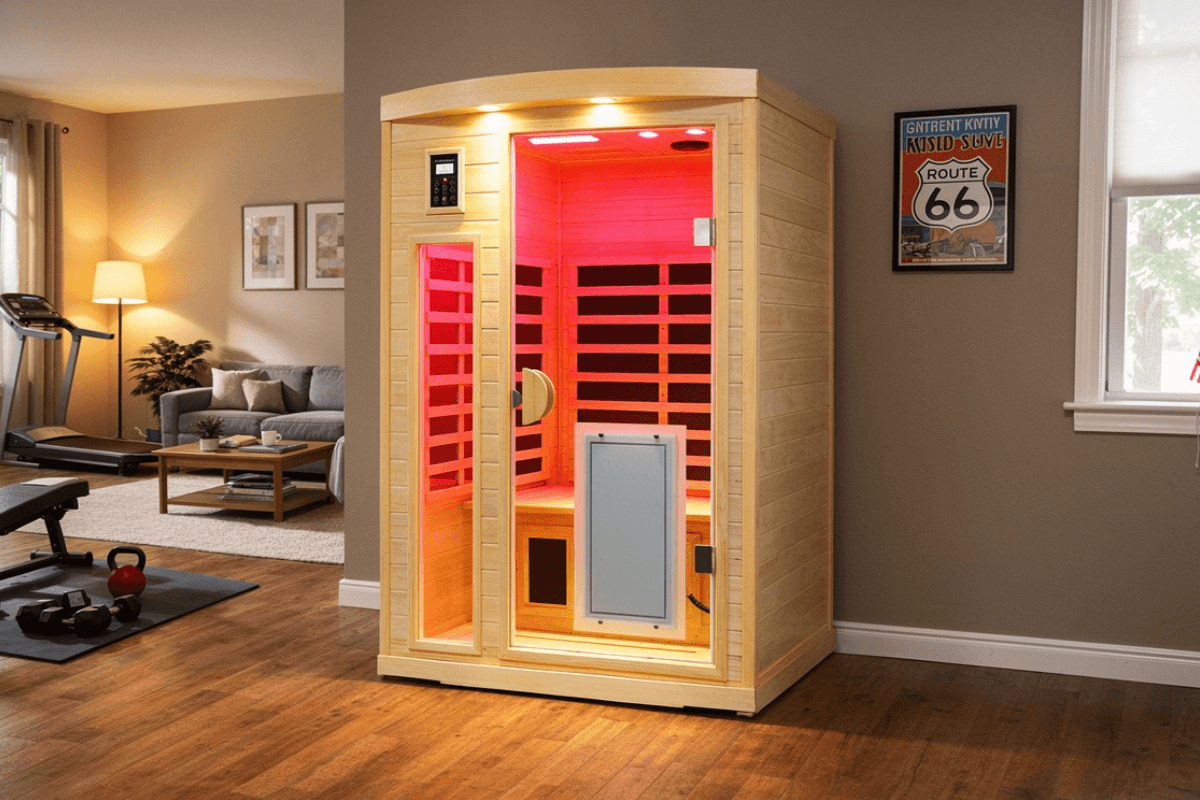
The main attraction is still the sauna itself: a two-person, ultra-low EMF far-infrared cabin designed for regular home use.
But the upgraded red-light system gives it another reason to stand out.
The 902BHN combines the FIR heating experience with 660nm red light and 850nm near-infrared light. Instead of treating red light as a decorative color inside the cabin, SalusHEAT gives customers a specified red/NIR system that can be used as part of the sauna routine.
And there is a surprisingly practical advantage to having it built in.
You don't need to buy a sauna first and then figure out where you're going to put a separate red-light panel.
You already have the space. You're already sitting there.
One Customer Actually Tested It
One of the more interesting 902BHN reviews comes from Roger in Indiana.
He didn't simply say the sauna looked good. He explained that he spent a lot of time comparing models, including higher-end units, and personally tested EMF and electric fields after buying the Maxwell.
He also specifically liked the red-light setup. His review notes that the ceiling-mounted red light came pre-installed, while SalusHEAT also offers an adjustable red-light bullet option that can be directed toward a particular area of the body.
That last detail is easy to miss when comparing sauna specifications, but it is exactly the kind of thing an experienced buyer notices: where the light is, how you use it and whether it is actually convenient.
Roger also praised the clean materials, tight fit, easy assembly and the fact that the cabin required no complicated tools.
It's Not Just One Review
Another 902BHN customer, Julie from Minnesota, listed her priorities before buying: 360-degree heating panels, easy installation, low EMF, quick warm-up and a true red-light therapy option.
That list is revealing because it looks a lot like the checklist many serious sauna buyers eventually create for themselves.
Not "How many features does it have?"
More like: Does it heat evenly? Is it comfortable? Is the EMF low? Does the red-light system actually give me something useful? Will I use it often?
SalusHEAT's review page also includes customers who mention using their cabins regularly and appreciating the built-in red-light feature. One 907BHN owner specifically said his wife loved the red light already installed in the sauna.
Near Infrared vs. Far Infrared: Which Is Better for You?
| If Your Priority Is... | Consider... |
|---|---|
| Relaxation | Far infrared |
| Sweating | Far infrared |
| Regular home sauna use | Far infrared |
| Exercise recovery | FIR + red/NIR |
| Skin-focused light therapy | Red light + NIR |
| One integrated wellness setup | Full-spectrum or FIR + red/NIR |
If you mainly want a sauna, you don't need to overthink this. A quality FIR system can give you the heat experience you're looking for.
If you also want red and near-infrared light, however, an integrated system starts to make more sense.
That is probably the sweet spot of the 902BHN: it doesn't force you to choose between a good infrared sauna and having red-light technology.
What About a Full Spectrum Infrared Sauna?
"Full spectrum" sounds impressive, but the phrase itself isn't enough to make a sauna good.
A full-spectrum system typically combines different infrared wavelengths, often including FIR, NIR and sometimes red light.
The advantage is flexibility. You get the thermal experience of an infrared sauna while also having access to light-based technology.
The downside is that the term can become a marketing shortcut.
Two saunas can both call themselves "full spectrum" while offering very different heater layouts, light output and overall build quality.
That's why wavelength specifications are more useful than the label alone.
If you are interested in full-spectrum saunas, take a look at our explanation: Full Spectrum vs. Far-Infrared Sauna: Which Is Better?
When you see "full spectrum," look one level deeper. Check the actual wavelengths, heater coverage, EMF information, cabin construction and warranty. The more expensive sauna isn't automatically the better engineered one.
What About a Portable Sauna?
A portable sauna can make sense if you rent, have limited space or simply don't want a permanent cabin.
But don't expect every portable model to feel like a full-size infrared cabin.
Cabin size, heater placement, insulation and body position all affect the experience. A portable unit can be convenient, but a dedicated two-person cabin may be more comfortable if you plan to use it several times a week.
That's where a model like the 902BHN fits nicely. It isn't enormous, but it gives you enough space for two people without turning the sauna into a major construction project.
What If You Want an Outdoor Sauna?
If indoor space is limited, an outdoor sauna or exterior sauna can be a great alternative.
Searches such as sauna outside and outdoor sauna near me are becoming increasingly common as homeowners turn patios, backyards and dedicated outdoor spaces into wellness areas.
Outdoor installation does require more planning. Weather protection, insulation, electrical service, foundation and local requirements all matter.
The same principle applies here: don't buy based only on the feature list. Think about how the sauna will actually live in your home.
How to Compare an Infrared Sauna Before Buying
Whether you're searching for infrared saunas near me, IR sauna near me or browsing an online sauna for sale, start with these questions:
- How is the cabin heated? Look at the actual heater layout, not just the heater count.
- Does the heat feel even? Good coverage matters more than a big number on a specification sheet.
- What are the EMF measurements? If low EMF matters to you, look for real testing.
- What wavelengths does the red/NIR system use? 660nm and 850nm are much more useful information than simply "red light."
- Can you actually fit the sauna in your home? Measure the room and the path to get it there.
- Will you use it regularly? This might be the most important question of all.
The Sauna You'll Actually Use Is the One That Matters
There's a tendency in the sauna industry to make everything sound more complicated than it needs to be.
More wavelengths.
More heaters.
Higher temperatures.
More features.
But after you've lived with a sauna for a while, the priorities usually get simpler.
Does it heat evenly?
Is it comfortable?
Does it warm up quickly enough?
Does it fit your space?
Do you actually enjoy sitting in it?
And if you wanted red-light therapy, does the red-light system give you enough information to know what you're actually getting?
Those questions are more useful than a giant feature list.
Why the 902BHN Is Worth a Look
The Maxwell-902BHN is designed around a fairly simple idea: make the everyday sauna experience good first, then add technology that people can actually use.
You get the two-person FIR cabin, ultra-low EMF heating, broad heater coverage and the practical design that customers have repeatedly mentioned in their reviews.
Then there's the part that makes the upgraded version particularly interesting: integrated red and near-infrared light using 660nm red light and 850nm NIR.
That's a useful distinction when you're comparing products. You're not just buying a cabin with red-colored mood lighting. You're getting a sauna designed around FIR heat with a dedicated red/NIR feature built into the experience.
And if you eventually decide you want to use the red light more selectively, SalusHEAT also offers an adjustable red-light option on the Maxwell line, giving you more control over where the light is directed.
- Two-person home sauna design
- Ultra-low EMF far-infrared heating
- Broad heating coverage
- Integrated 660nm red light and 850nm near-infrared light
- Optional adjustable red-light therapy configuration
- Compact enough for practical home installation
That's probably why the 902BHN is worth considering for buyers who want more than a basic FIR sauna but don't necessarily want to build an entire separate red-light therapy setup.
Frequently Asked Questions
Is near infrared better than far infrared?
No. They do different things. FIR is primarily for sauna heat; NIR is more closely associated with light-based therapy.
What is 660nm red light?
660nm is a commonly studied red-light wavelength used in photobiomodulation research.
What is 850nm near infrared?
850nm is a near-infrared wavelength commonly used in red and NIR light therapy systems.
Is a full spectrum sauna worth it?
It can be if you want FIR heat plus red/NIR light in one cabin. Just check the actual specifications.
Does every sauna red light provide therapy?
No. Some are mainly decorative. Look for specific wavelengths and product details.
Is the 902BHN a good option for home use?
It's worth considering if you want a two-person FIR sauna with ultra-low EMF heating and integrated red/NIR light.
Should I choose an indoor or outdoor sauna?
Choose based on your available space, installation requirements and how often you expect to use it.
The Bottom Line
Near infrared and far infrared aren't really rivals.
Far infrared gives you the heat.
Near infrared and red light add another layer.
If all you want is a comfortable sauna you can use regularly, a well-built FIR cabin may be all you need.
If you're interested in adding red and near-infrared light without buying a separate device, a thoughtfully designed full-spectrum or FIR + red/NIR sauna becomes much more interesting.
That's what makes the Maxwell-902BHN worth a look. The appeal isn't that it has the longest feature list. It's that the important pieces are combined in a practical two-person cabin: FIR heating, ultra-low EMF design and a specified 660nm red light + 850nm near-infrared system.
For someone building a wellness routine at home, that may be enough.
Not more technology for the sake of technology.
Just a sauna you'll actually want to use.
