
Why Is Sauna Glass Tinted? Choosing Between Green, Tea and Clear
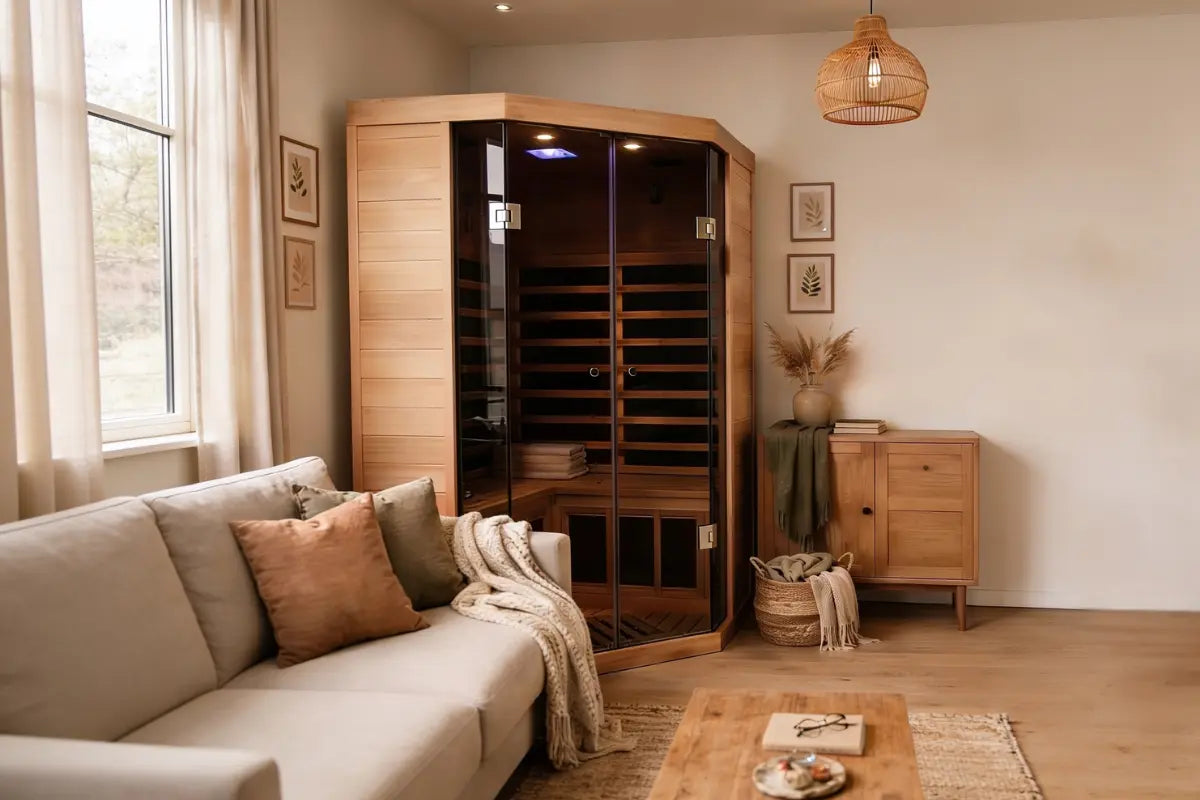
People ask us about heaters, wood, EMF, and price.
Almost nobody asks about the glass.
Which is odd, when you think about it. Glass is the part of a sauna you look through, lean back against, and open fifty times a year.
It's also the first place a cheap cabin cuts. Glass is one of the most expensive components on the unit, and it doesn't show up anywhere on a comparison chart.
Two cabins with identical heater counts and identical wood can have a very different front wall.
The question does arrive eventually, usually right after someone compares listings. "Why does your glass look dark in the photos? I saw another cabin with clear glass."
It's a fair question. And the honest answer says more about a cabin than the heater count does.
Glass in a sauna is not a window and it isn't decoration. It's an insulation panel and a structural one.
It holds heat in, it keeps the door square through hundreds of heat cycles, and it's the largest single surface between your cabin and the room around it.
Thickness decides how well it does that, and it decides how often a pane survives the trip to your house and the years after it. Tint decides how the cabin feels to sit in.
The One Spec That Never Makes It Onto the Chart
Open a few sauna listings side by side and you'll see the same numbers in the same order: number of heaters, heating technology, wood species, EMF range, capacity, price. Occasionally a warranty line.
What you will almost never see is a millimetre figure for the glass.
That's not an accident. It's the easiest spec to leave vague, because "tempered glass" sounds like a complete specification and it isn't.
Tempered describes how the glass was treated for safety. It says nothing about how thick it is, what colour it is, or how well it insulates.
So here's the thing worth doing before you buy anything. Ask for the glass thickness.
If the answer is a number, you're talking to someone who knows their product. If the answer is "standard safety glass," you've just learned where the corners were cut.
What Thin Glass Actually Costs You
Nothing dramatic happens. That's what makes it easy to miss.
Thin glass doesn't fail in a week. It just quietly makes the cabin a little worse at everything, all the time.
Heat leaves faster. Glass is a poor insulator at any thickness, and it gets meaningfully worse as it gets thinner. The cabin takes longer to reach temperature, and the heaters cycle on more often to hold it there.
You feel it as a cabin that's always working. That cost arrives every month on the electric bill rather than once at checkout.
The panel flexes. Heat makes materials move. A thin pane in a warm frame bows slightly, and over a season or two that movement works on the seal and the hinges.
This is where the classic second-year complaint comes from — the door doesn't line up anymore.
The wood and the heater usually get blamed. The glass is frequently the actual reason.
You hear it. A thin panel in a hot frame creaks, ticks, and rattles as it expands.
It's a small thing that becomes a constant one. A heavy pane sits still and stays quiet.
The edge is where it fails. Glass rarely breaks across its face. It fails at the edge, where there's the least material to absorb a knock — in transit, during assembly, or the day someone catches the corner with a bag.
Thin glass has a thin edge. And a chip at that edge can release the pane's internal stress and take the whole sheet with it.
Thicker glass simply has more material behind an impact. That extra material is the entire reason a knock stays a cosmetic mark instead of becoming a crack.
It fogs and condenses. On an outdoor cabin especially, a single thin pane is where condensation forms first, because it's the coldest surface in the assembly.
Which brings us to the part that matters most for anyone buying an outdoor model.
If your cabin lives outside, glass stops being a cosmetic choice. A single-pane front wall in a climate with real winters loses heat all night and collects condensation on the inside of the glass.
This is one of the reasons outdoor units should be specified with double-glazed construction — two panes with a sealed gap between them — rather than a single sheet in a heavier frame.
Ask before you buy. It's not a detail any listing volunteers.
The Difference, Measured in Millimetres
Our glass runs 1 to 2 mm thicker than the panes used on most cabins sold at this price point.
That number sounds abstract until you handle it.
A thicker pane has more mass, and mass is where the useful properties come from. It holds heat longer. It resists bowing under thermal movement. It damps sound. And it gives the frame something solid to hold onto.
The most obvious difference is the door itself. Close a thin panel and you get a light, slightly hollow feel with a bit of flex.
Close a thick one and you get a low, solid thunk that doesn't move afterwards. It's the same reason a good car door sounds different from a cheap one — the material is doing the work, not the latch.
The less obvious difference is how rarely it arrives broken.
One to two millimetres doesn't sound like much, until you remember that glass fails at the edge. A thicker pane carries more material exactly where the impact lands.
Across a few hundred cabins, that's the difference between the breakage rate we have and the one we hear about from owners replacing a thin-pane unit.
It's also why a cabin that gets shipped to your driveway and assembled by two people on a Saturday is a reasonable thing to expect, rather than a gamble.
Thickness isn't taken on trust. Every batch of glass is measured again at the factory before the cabin is packed — pane by pane, against the specification we ordered.
Glass is the component most likely to be quietly substituted. It looks identical in a product photo, and it's one of the largest single lines on the bill of materials. That makes it the one worth re-checking rather than assuming.
So we do. It's a slow, unglamorous step that no customer will ever see. It's also the reason we can tell you the number instead of describing the glass as "premium."
Green, Tea, or Clear? What the Tint Actually Decides
This is the part people notice first in photos, so let's settle it properly: we build cabins in all three. Green-tinted, dark tea-tinted — the one people usually call bronze or simply "dark" — and clear.
They share the same thickness, the same tempered specification, and the same factory measurement.
The tint is not a quality tier. It's a choice about light, and the right answer depends on where the cabin is going.
Tea glass (dark). The one most owners pick after living with clear.
It gives you back your privacy. At night, with the interior lit, clear glass turns a sauna into a lit box in the middle of the room, and it throws a reflected image of the room back at you while you sit there.
Tea glass softens both considerably. It reads as a piece of furniture rather than a specimen jar.
Green glass. Same practical benefits as tea, with a cooler, slightly greyer tone instead of warm brown.
It cuts glare the same way, hides the same streaks, and looks a little more contemporary against pale wood. If you're deciding between tea and green, it's entirely a colour question — there is no performance argument either way.
Clear glass. Brightest interior of the three, and the one to choose if the cabin is going somewhere dim — a basement with no nearby window, a garage, a north-facing room.
You lose the privacy, and you'll spend more time chasing water spots and fingerprints. But you get the most daylight of any option.
One thing worth separating out, because it's the most common confusion in this category: clear glass is the cheapest option on the market, which is why so many budget cabins default to it.
That's a statement about their clear glass — not about ours.
Our clear panes are the same thickness and the same tempered specification as our tinted ones, and they clear the same factory check. If you want a bright cabin, you can have one without trading away the material behind it.
Which leaves the real argument for tint. And it's about living with the thing, rather than about specs on a page.
Tinted glass costs us more. Here's what that money buys.
It controls glare. This matters much more outdoors. A clear glass front in direct summer sun turns the interior into a greenhouse and throws hard light and reflections around inside the cabin.
Tinted glass reduces both, so the cabin stays calmer in the middle of the day.
It hides the maintenance. Clear glass shows everything: water spots, dried sweat streaks, fingerprints, the faint haze that builds on any surface near a heater.
Tinted glass masks most of it. Anyone who has owned a clear-glass cabin knows exactly how much time gets spent chasing streaks on it.
It looks deliberate. A tea-brown or green-grey front wall reads as a considered material choice. Clear glass reads as a shower door.
In a room you're going to look at every day, that difference lasts longer than any spec.
The tint sits on the outermost surface of the cabin, while the infrared that warms you comes from panels mounted inside. So the glass tint never filters your session — it isn't standing between you and the heat, it's standing between the cabin and the room.
What it affects is visible light: how much daylight comes in, how much glare you get, and how much of the interior is visible from outside.
For a full-spectrum or red-light session in particular, the panels inside are doing the work, and the door tint is irrelevant to it.
One honest trade-off, since we'd rather you buy the right cabin than the one with the best photos: tinted glass does reduce the daylight coming in.
If your cabin is going in a dim basement with no window nearby and you genuinely want it as bright as possible inside, clear glass wins on that one narrow point — and ours is a perfectly good clear pane.
For almost every other setting — a bedroom, a den, a patio, a garage with a window — the tint is the better call.
Tempered, and How to Check It Before You Buy
Every pane in a sauna should be tempered safety glass. That's not a premium feature; it's the baseline.

Tempered glass is designed to break into small blunt pieces instead of long shards if something goes wrong. Two things worth knowing as a buyer:
- Tempered glass usually carries a small marking etched near an edge or corner — a standard safety-glazing identifier. If a seller can't tell you whether their glass is tempered, treat that as your answer.
- Never drill into it, and never use an abrasive cleaner on it. Tempered glass is strong across its face, but a chip or a drilled hole at an edge can release the internal stress and shatter the whole pane. If you want a towel hook on a glass-fronted cabin, it needs to mount to the wood frame — which is the entire reason the accessory we'll get to shortly is shaped the way it is.
What to Look At Before You Commit
If you're comparing cabins — in a showroom, at a friend's house, or across a set of product photos — these are the six things that tell you the most about the glass.
| What to Check | Why It Matters | Red Flag |
|---|---|---|
| Pane thickness | Drives heat retention, rigidity, edge strength, and how long the door stays aligned | A listing that says "tempered glass" but gives no thickness at all |
| Tint | Controls glare, privacy, visible light, and how the cabin reads in a room | Photos where the glass throws a hard mirror image back at the camera |
| Single vs double glazed | Decides condensation and overnight heat loss, especially outdoors | An outdoor model with no mention of glazing construction |
| Frame and seal | Keeps the door square through years of heat cycles | Glass sitting in a thin channel with visible gaps at the corners |
| Door hardware | Handles the weight of a heavy pane without sagging | Lightweight hinges and a single latch on a large glass door |
| Edge finish | Seals properly and stays safe to handle | Rough or unfinished edges, visible chips |
A Glass-Fronted Cabin Needs Somewhere to Put Things
Here's the small practical problem nobody mentions when they're talking about glass: you can't screw anything into it.
And you shouldn't want to.
Which means every owner of a glass-fronted cabin solves the same three problems in the same improvised way during their first month.
The towel ends up on the floor, or draped over the glass where it hides the view you paid for.
The water bottle stays outside the cabin, so nobody drinks during a session and everyone catches up afterwards.
And if you add essential oils, the bottle lives on the bench behind you, where you can't reach it without turning around.
That's why our accessory line exists. Not to pad a cart, but because we kept watching owners solve those three problems with a kitchen chair and a folded towel.
We wrote the whole reasoning out step by step in our guide to infrared sauna accessories, in the order people actually run into them.
Our three-piece sauna set covers all three at once: a towel rack that mounts to the wood frame rather than the glass, a cup holder that puts your water where you can reach it without standing up, and an oil holder for anyone who adds essential oils to a session.
These aren't generic parts pulled off a shelf and dropped into a box. Each one was developed from what customers actually told us they were missing, built thicker than the usual version of the same item, and made to survive heat and moisture rather than look right in a photo.
Walk into most accessory aisles and you'll find the same four or five identical holders sold under a dozen brand names. Ours are made to our own drawings, in heavier material, because a towel rack that sags in month three isn't worth the twenty dollars you saved.
It's the same three items our accessory guide walks through one at a time, bundled so you're not ordering them separately and discovering in week three that you missed one — and priced at cost, because we'd rather you have the complete setup than save us a few dollars on a rack. You'll find it in the accessories collection.
It's a small thing next to the price of a cabin. It's also the difference between a sauna you use and a sauna you set up once and admire.
What a Big Ad Budget Doesn't Tell You
There are websites in this category that are genuinely impressive to look at. Beautiful photography, a slick product page, a brand voice that sounds like it's been doing this for decades.
Some of them are excellent.
Some of them are selling you a cabin with a thinner front wall than the one you're reading about right now. The polish is how they get away with it.
Here's the part worth thinking about. Marketing has to be paid for, and it's never paid for out of the marketing budget.
It comes out of the bill of materials — thinner glass, commodity hardware, generic accessories, a heater count that sounds better on a page than it performs in a room.
Every dollar that goes into looking premium is a dollar that didn't go into being premium.
We've made the opposite trade. We've put real money into the parts that photograph badly and matter enormously: the glass thickness, the inspection step at the factory, accessories we tool and build ourselves rather than buy in.
Then we kept the price where a family can actually reach it. Spending that much on research and development and then charging showroom prices for it would defeat the point.
Factory-direct is what makes that possible. There's no showroom to staff, no dealer margin added on top, no middle layer taking a cut for the privilege of handing you a box.
The money goes into the cabin instead.
So when a listing looks slicker than ours and costs less, the honest question isn't "why are they cheaper."
It's "which component paid for the difference." Glass is the first place to look, and now you know what to ask.
Keeping Tinted Glass Looking New
Tinted glass is easy to live with, and only slightly less forgiving than clear if you clean it wrong. The same routine works on all three tints.
- Water and a drop of mild dish soap. That's the whole kit. A soft microfiber cloth finishes it without streaks.
- Skip ammonia-based glass cleaners and anything abrasive. Harsh chemicals can dull a tinted surface over time, and scrubbing pads risk a chip at an edge — which is the one thing that can take a tempered pane out entirely.
- Wipe the inside after a session. Dried sweat leaves a faint film that builds up slowly and eventually becomes visible as a hazy patch, especially in the corner nearest the heater. Ten seconds with a dry cloth while the glass is still warm handles it.
- Look at the seal once a season. Run a finger along the door frame and check that the glass still sits evenly with no gap opening at a corner. That single check catches most alignment issues while they're still adjustable.
The Bottom Line
Glass is the least-discussed and most-felt component in a sauna.
Thicker glass holds heat better. It keeps its alignment longer. It resists the knocks that break thin panes. It stays quiet. And it gives you a door that closes like something substantial.
Tinted tea or green glass controls glare, gives you back your privacy, hides the streaks, and makes the cabin look like furniture instead of a shower stall.
Clear glass gets you the brightest possible cabin without giving up any of the material quality — it's a difference in light, not in grade.
Neither the thickness nor the tint shows up in a comparison chart. Both are things you notice every single session.
It's also worth knowing where the rest of the money goes, and which parts of a sauna you can legitimately save on. We broke that down in our guide to what an infrared sauna actually costs.
Frequently Asked Questions
What kind of glass is used in an infrared sauna?
Tempered safety glass, which is heat-treated so it breaks into small blunt pieces rather than shards if it fails. The specs that separate one cabin from another are the thickness of the pane and whether it's tinted or clear. Tempered glass is the baseline, not the differentiator.
Do you offer clear glass, or only tinted?
All three. Green-tinted, dark tea-tinted and clear are built to the same thickness and the same tempered specification, and all three go through the same measurement check at the factory. The tint decides the light in the room; it doesn't decide the quality of the pane.
Why is infrared sauna glass often tinted instead of clear?
Privacy, glare control, and maintenance. Tinted glass keeps the interior from becoming a lit display case at night, cuts hard sunlight and reflections, and conceals the water spots and streaks that show instantly on clear glass. Clear has one real advantage — the brightest interior — which matters most in a dim room.
How thick should sauna glass be?
Thicker is better for heat retention, rigidity and edge strength. Ours runs 1 to 2 mm thicker than the panes on most cabins at this price. That's small on paper and immediately obvious the first time you close the door. The practical test when you're shopping is simple: ask for a number. A seller who can give you one knows their product; a seller who answers "standard safety glass" doesn't want you asking.
How is the glass thickness verified before shipping?
Every batch is measured again at the factory before the cabin is packed, pane by pane, against the specification we ordered. Glass is the component most likely to be quietly substituted, because it looks identical in a photo, so it gets re-checked rather than assumed. It's a slow step no customer ever sees, and it's why we can quote a number.
Does thicker glass reduce breakage?
Yes, and it's the most underrated reason to care. Glass fails at its edge, where there's the least material to absorb a knock — in transit, during assembly, or when someone catches a corner. A thicker pane has more material behind that impact, so a knock tends to stay a cosmetic mark rather than becoming a crack.
Does thicker glass make a sauna more energy efficient?
Yes. Glass is a weak insulator compared to a solid wall, and it improves as it gets thicker and as you move to double-glazed construction. A better-insulated front wall means the cabin reaches temperature faster and the heaters cycle less often to hold it there, which shows up in running cost rather than at checkout.
Does tinted glass block the infrared heat or the health benefits?
No. The infrared that warms you comes from heating panels mounted inside the cabin. The door and window glass sits on the outside, so the tint is never between you and the heat — it only affects visible light coming in from outside.
What's the difference between single and double glazing on a sauna?
Double glazing means two panes with a sealed gap between them, which is the meaningful upgrade for an outdoor cabin. A single pane is the coldest surface in the assembly, so it's where condensation forms and where heat escapes fastest overnight. It's the spec worth confirming in writing for any outdoor model.
Can I attach a towel rack to the glass on my sauna?
No — and you shouldn't try. Drilling or clamping tempered glass risks a chip at the edge, and a chip can release the pane's internal stress and shatter the whole thing. Anything you mount needs to attach to the wood frame. A rack designed for a sauna mounts to the frame, not the glass.
How do you clean sauna glass?
Warm water with a drop of mild dish soap, then a soft microfiber cloth — the same routine for clear, tea or green. Avoid ammonia-based cleaners and anything abrasive, which can dull a tinted surface over time. Wiping the inside down while the glass is still warm from a session stops sweat residue from building into a haze.
We've been building sauna products since 2004, and glass is one of the places where we deliberately spend more than the category does. Our panes run 1 to 2 mm thicker than the standard at this price, every batch is measured again before packing, and we build in all three tints — green, dark tea and clear — so you can choose the light you want without choosing a lesser pane.
We also sell factory-direct, so that material difference doesn't come with a showroom markup on top of it. And our accessories are developed from what customers tell us they need, built thicker than the generic version, and priced at cost rather than marked up. You can see the full range at salusheat.com/collections/all-products.
- Green-tinted, dark tea-tinted and clear tempered glass — same thickness, same spec, your choice of light
- Panes 1 to 2 mm thicker than the category standard at this price
- Every batch re-measured at the factory before packing
- Double-glazed construction on outdoor models, for condensation and overnight heat loss
- Three-piece accessory set — towel rack, cup holder, oil holder — self-developed, built thicker, mounted to the frame rather than the glass, priced at cost
- Factory-direct, so the material cost lands in the cabin rather than in a showroom
The glass is the part you'll notice every single session without ever thinking about it again.
If you're still shopping, what's the one thing on your list you can't find a straight answer about? Tell us in the comments below. We read them.
This article is for informational purposes only and does not constitute medical advice. Heat tolerance varies by individual. Children, older adults, and anyone managing a cardiovascular condition, who is pregnant, or who takes medication that affects heat response should consult a physician before using a sauna, and should keep sessions shorter and temperatures lower.
