
2-Person Outdoor Sauna: What Couples Measure Before They Buy
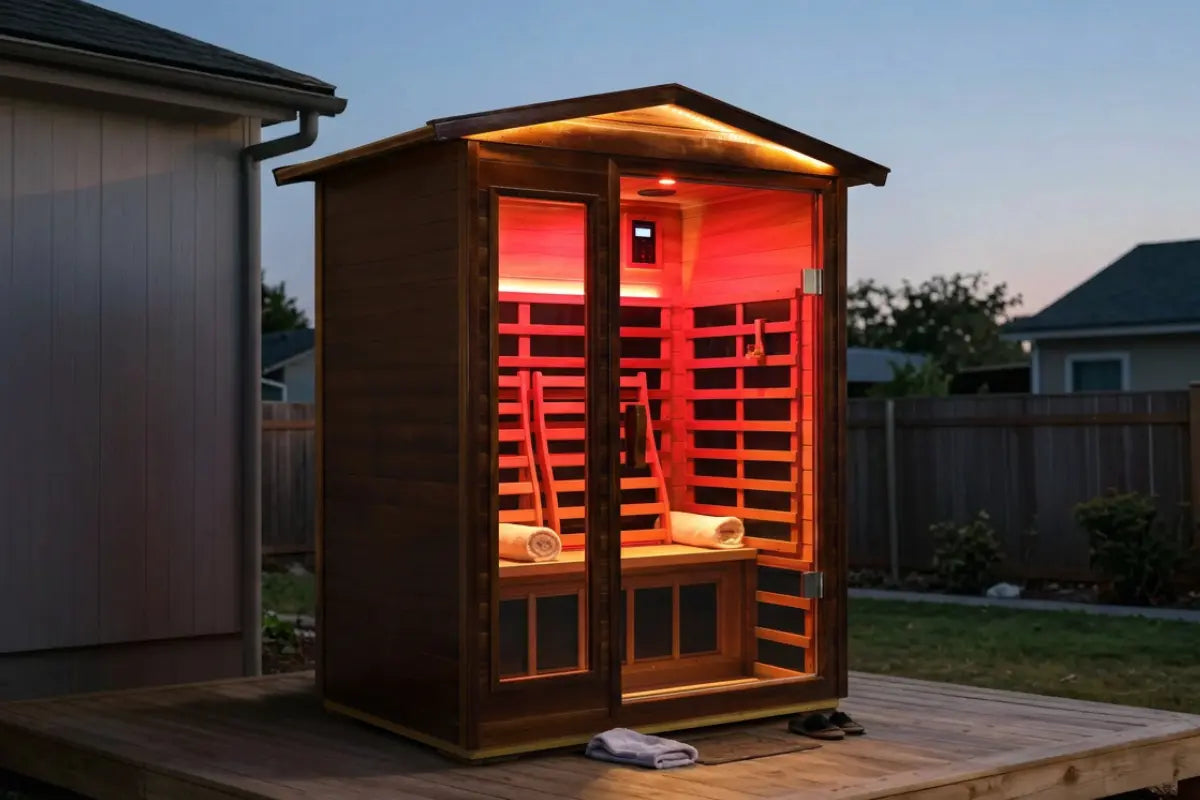
The photo we get most often from two-person buyers isn't of the sauna.
It's a tape measure, lying on a deck.
Sometimes there's a shoe beside it for scale. Sometimes a dog. But the tape is always stretched out, and the message underneath is always the same question: is this going to fit here?
That photograph says a lot about who buys a two-person outdoor cabin. They're not dreaming about a spa. They're standing on a deck they already own, working out whether a box can go there without ruining it.
It's a good question, and it deserves a proper answer rather than a brochure.
Why Two People Became the Default
Ten years ago, most outdoor cabins sold were either very small or very large. That's changed, and it isn't because of marketing.
A one-person cabin is genuinely tight. Anyone over about five foot nine has to think about where their knees go, and leaning back isn't really an option. It's fine for a quick hot twenty minutes, not for the session people actually keep doing.
A four-person cabin solves that, then creates two new problems. It costs more. And it's a bigger box to heat, which outdoors means a longer wait before you can get in.
Two people sits in the gap. It's the smallest size where an adult can lean back properly, put their feet up on the lower bench, and stay for twenty minutes without negotiating with the walls.
Most two-person cabins are bought by couples and used by one person at a time.
That isn't a disappointment — it's the point. The second seat isn't wasted space, it's legroom. It's the difference between sitting in a booth and sitting on a stool, and it's the reason a two-person cabin gets used four nights a week while a one-person cabin gets used on weekends.
Why Outdoors, and Why Now
Four things pushed outdoor cabins from a niche to the default choice for anyone with a yard.
Indoor space stopped being free. A sauna in the house means giving up a room, or carving a corner out of a basement. Most homes don't have a spare room to donate. The yard does.
Nobody wants the moisture inside. Even a dry sauna puts heat and humidity into the structure it's attached to. Outdoors, that problem simply doesn't exist.
The cool-down became the attraction. This is the part people don't expect. Sitting in heat is nice. Stepping out of it into forty-degree air is what makes you feel alive, and you can't do that in a hallway. We wrote about a full year of that in an outdoor sauna through four seasons.
Backyards turned into rooms. Decks, pergolas, outdoor kitchens, fire pits. The same shift that made people invest in their yard made a cedar cabin look reasonable rather than strange.
There's a quieter reason too. An outdoor cabin is the rare wellness purchase that also improves the property. Owners tell us guests assume theirs came with the house.
What Two-Person Buyers Actually Weigh
We've talked this through with a great many customers over the years, and the questions arrive in a fairly consistent order.
What's worth noticing is that almost none of them are about heaters.
The tape measure
Will it fit between the house and the fence, and will it still leave a walkway.
A two-person cabin is compact, but "compact" isn't a number. Measure the gap, then take off a foot on each side for walking around it and for the roof runoff.
What's holding it up
An existing deck is usually the plan. The question is whether that deck was built for a concentrated load in one corner.
A cabin with two benches, a heater and two adults is a very different thing from a patio table.
How it gets to the back
This one catches people out. A pallet has to come through a gate, around a corner, up or down steps.
If the gate is thirty inches wide and the panels are wider, that's a problem no amount of planning inside the yard will solve.
Power
Whether there's an outdoor outlet nearby, and whether the circuit can take the draw.
It's a small job for an electrician and a large annoyance if you discover it on delivery morning. We go through the electrical side in whether you can put an infrared sauna outside.
Winter
Almost every two-person buyer asks some version of "will I actually use it in January."
The honest answer is yes, more than in July — as long as the path is clear and the door isn't buried. What changes in cold weather is preheat time, not usability.
Privacy
Who can see the door from their window, and whether tinted glass is enough.
Usually it is. Occasionally a fence panel settles it.
Whether both people will really fit
Couples ask this more than anyone else, and usually about shoulders rather than width.
The answer depends on bench depth more than cabin width, which is why the inside dimensions matter more than the outside ones.
The Part Buyers Underestimate
Almost nobody asks how the door closes.
It sounds trivial until you've owned a cabin for three winters. The door is the only moving part on the whole structure, and the seal around it is the first thing to fail.
Water collecting in the channel under the glass is what starts that failure.
Which is why the roof matters more than most buyers expect. A pitched roof carries water away in two directions and produces an overhang past the door almost as a byproduct — and that overhang is what keeps the seal dry. We went through the geometry in why our roof is a classic American gable.
It's also the one thing you can't add later. Heaters can be upgraded. A roof can't.
Before you order, walk the delivery path with a tape measure rather than your eyes.
Gate width, step depth, the tight corner by the downspout, the height of the overhang you'll pass under. Freight arrives on a pallet and it doesn't bend.
Ten minutes with a tape now saves a very awkward morning later.
Red Cedar: The Wood People Come Back To Talk About
If there's one thing we're asked about more than dimensions, it's the smell.
Red cedar is the aristocrat of sauna woods, and it earns that name on three counts.
The timber itself. It's a finer, tighter-grained wood than the softwoods used on cheaper cabins, with natural oils that resist moisture without any chemical treatment. That's why it's been the standard for decks, shingles and boats for a century.
The scent. Cedar gives off a soft, dry, resinous fragrance — the smell of a cedar chest, not a perfume. It's strongest in the first few months, and it comes back every time the cabin warms up.
Many owners tell us that's the part they didn't expect to love: opening the door on a cold evening and getting that smell before they've even sat down.
How it ages. It starts a warm reddish-brown and silvers to a soft grey over a few seasons. Some people oil it to hold the original colour; most let it weather, because silvered cedar suits a garden better than a cabin that still looks new.
It is the most expensive wood we offer, and we'd rather say so plainly. The grain, the oils, the fragrance and the way it behaves in weather are all part of what that price buys.
Cedar is a softer wood, so a knocked corner will show a mark. That softness is also why it's light enough for two people to carry around the side of a house.
Treat the small marks as patina rather than damage. A cabin that has been lived with looks better than one that's been protected from its own garden.
And Then There's Mahogany
Mahogany is the other option, and it suits a different set of priorities.
It's denser and heavier, with a finer, more uniform grain and a deeper reddish-brown that holds its colour longer than cedar does.
What it doesn't have is the fragrance. If the cedar smell is what sold you, mahogany won't deliver it.
Buyers tend to choose it for two reasons: they're matching existing mahogany decking or fencing, or they want a cabin that still looks finished in year five without re-oiling.
It comes in below cedar on price, and for those buyers that's never been the deciding factor.
| Wood | What It Brings | Who Chooses It |
|---|---|---|
| Red cedar | Fine grain, natural oils, a soft resinous scent that returns whenever the cabin warms, silvering to grey over time. The most expensive wood we offer. | Anyone who wants the smell, the grain and the way cedar weathers — most two-person buyers |
| Mahogany | Denser and heavier, uniform grain, deeper colour that holds longer. No fragrance. | Anyone matching mahogany decking, or who wants it to keep looking finished |
Neither needs much. A wash once a year, and a re-oiling every few seasons if you'd rather keep the original colour than let it weather.
Where the 902VR Fits
The 902VR is the red cedar two-person outdoor cabin, which is why it's the model most of our two-person customers end up on.
It measures just under five feet wide including the roof, around eighty inches tall and about three and a half feet deep — small enough for a standard deck, deep enough that the upper bench works as a backrest rather than a shelf.
It carries a classic gable roof with projecting eaves, a double-glazed front wall, and low EMF readings between 0.1 and 1.0 mG.
Most buyers choose it for the cedar. That's the honest summary: the dimensions get it onto the deck, and the wood is what they talk about afterwards.
If you'd like the full specification rather than our summary, it's on the Wearwell-902VR product page.[Note: We are currently in the midst of our Black Friday sale, making this the best time to purchase any SalusHeat products—if you’ve been considering a red cedar sauna, now is a great time to buy.]
What Ownership Looks Like After a Year
Four things tend to be true by the second winter.
You use it alone most of the time. The other seat is legroom, and nobody regrets it.
Your sessions get shorter. Twelve to eighteen minutes, most nights, rather than the forty-five minutes people imagine before they buy.
You stop thinking about the cabin. It becomes a thing you do after dinner, like walking the dog. That's a strange thing to aim for, but it's what separates the cabins that last from the ones that get resold.
You notice the roof more than the heater. Snow sliding off instead of sitting on it. The door still closing cleanly in February. Rain on the roof while you're inside.
Small things, every one of them, and all of them the reason the cabin still feels new.
The Bottom Line
Two-person outdoor cabins became the default because they solve a specific problem: enough room for one adult to properly relax, in a footprint that fits a deck most people already have.
The decisions that matter are the boring ones — the gap to the fence, the strength of the deck, the width of the gate, the shape of the roof.
The wood comes after that. And if you're drawn to cedar, it's usually the smell that decides it, long before the price does.
If you're still working out where it would go, the siting questions are covered in our outdoor sauna guide. If you've narrowed it to a size and want to compare models properly, that's in choosing an outdoor infrared sauna for a backyard.
Frequently Asked Questions
Is a two-person sauna big enough for two adults?
Yes, comfortably, if the bench is deep enough. Check inside dimensions rather than outside ones.
Do most people use a two-person sauna alone?
Yes. The second seat works as legroom and back support more than a shared space.
Will I use an outdoor sauna in winter?
More than in summer, for most owners. Allow a longer preheat and keep the path and door clear.
Why is red cedar more expensive than other sauna woods?
Finer grain, natural oils that resist moisture without treatment, and the fragrance. It's the aristocrat of sauna woods, and it's priced accordingly.
Does the cedar smell last?
Strongest in the first months, then softer. It returns whenever the cabin warms up, and after a light sanding.
Does a two-person cabin fit on an existing deck?
Usually, but check the deck's load rating. A loaded cabin is far heavier than patio furniture.
How much space should I leave around it?
About a foot on each side, plus clearance in front for the door and the roof runoff.
We've been building sauna products since 2004, and the two-person outdoor cabin is the model we sell most — not because we push it, but because it's the size that fits a real deck and a real evening.
The Wearwell outdoor range comes in red cedar and mahogany, with a classic gable roof, double-glazed front wall, and low EMF readings between 0.1 and 1.0 mG. Two-year warranty on heaters and electrical, one year on the wood, optional extensions.
- Two-person outdoor cabins in red cedar or mahogany
- Red cedar — fine grain, natural oils, and the scent owners talk about
- Classic American gable roof with eaves that carry past the door
- Double-glazed front wall, for condensation and overnight heat loss
- Low EMF readings of 0.1 to 1.0 mG
- Two-year warranty on heaters and electrical, one year on the wood
If you're anywhere nearby, come and sit in one before you decide. Ten minutes inside answers more than an hour of reading.
If you're still deciding, what's the number you're stuck on: the width, the deck, or the gate? Write to us either way. We answer every one.
This article is for informational purposes only. Any outdoor installation should follow the manufacturer's siting, clearance and electrical instructions, and local building or permit requirements where they apply. Heat tolerance varies by individual; consult a physician before sauna use if you manage a cardiovascular condition, are pregnant, or take medication affecting heat response.
