
Outdoor Sauna With Red Light: What It Actually Does (And How to Use It)
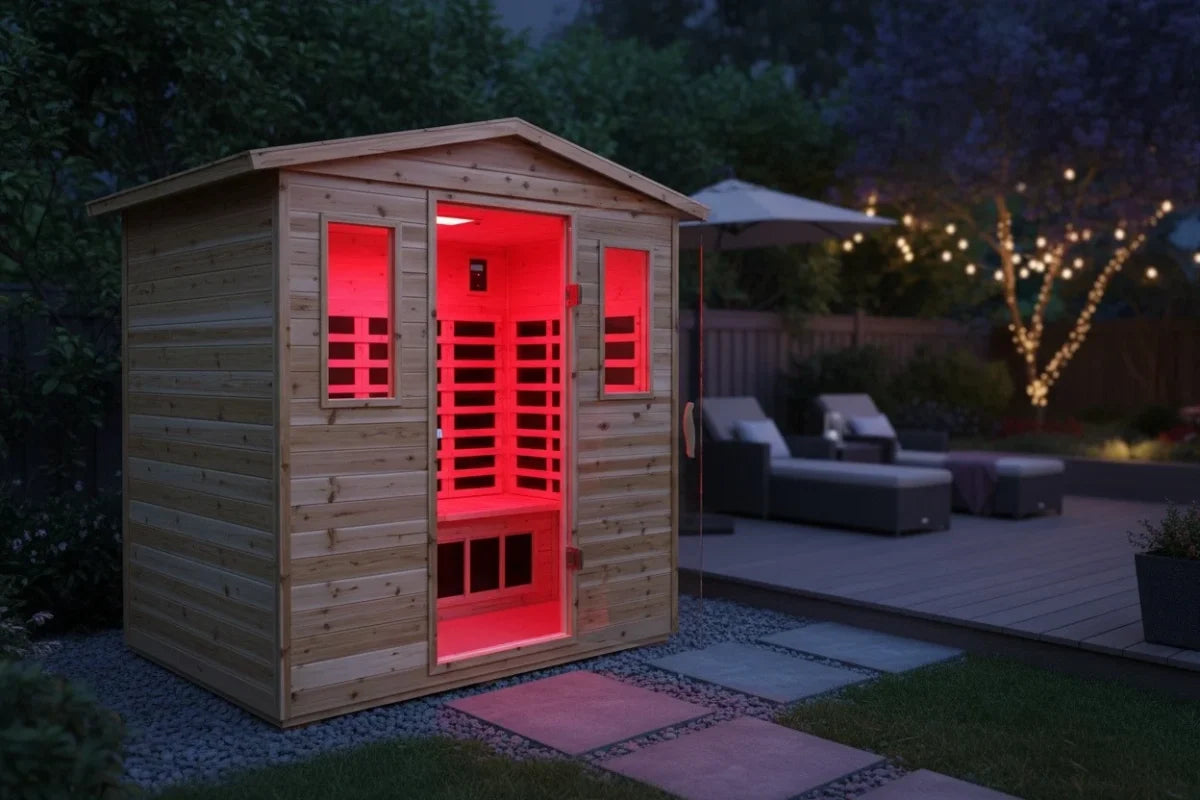
When you start thinking about buying a sauna for your home, the questions come naturally.
How hot does it get? What kind of wood is it made from? How low are the EMF levels? And, of course, is it worth the price?
These are the details that help you compare one sauna with another.
But there's another question that's easy to overlook: What will make you want to come back to it, week after week?
Because bringing a sauna home isn't just about adding another piece of equipment to your house. It's about creating a space for yourself — a place to slow down after a long day, step away from the noise, and make a little room for your own well-being.
That's where some of the smaller details can become surprisingly meaningful. Red light, for example, may not be the first feature you look for when comparing saunas. But as you settle into a routine, the experience it adds may become part of what makes your time in the cabin feel like your own.
What the Panel Actually Is
It's an LED array, not a lamp. That difference is the whole reason you can sit two feet from it.
A bulb puts out visible light and a lot of heat. An LED array puts out a narrow band of wavelength and almost no heat of its own, which means it can run inside a cabin that's already at 140 degrees without adding to the load.
Two wavelengths do the work.
660 nanometres is red. Visible, warm-looking, and it lands in the upper layers of the skin.
850 nanometres is near-infrared. Invisible, and it travels further — into muscle and joint tissue.
Between them, that's the entire mechanism. Everything else in the category is packaging.
What the Evidence Actually Supports
Three tiers, and the category usually flattens them into one.
Skin appearance is the strongest ground. There's a reasonable body of controlled work on texture, tone, and fine lines, and the results are modest but repeatable.
Muscle soreness and joint comfort sit in the middle. Some positive trials, plenty of small studies, and a fair amount of noise. Promising rather than settled.
Everything else is thin, mixed, or still being argued over by people who do this for a living.
Which is worth saying plainly, because the marketing in this category doesn't. A red light panel is a wellness feature. Anyone framing it as a treatment for a named condition is selling you something other than a sauna.
Red light is a habit product wearing the costume of a feature.
Its results come from frequency, not intensity. Twelve minutes five days a week does more than forty minutes once. Every other decision — which cabin, where the panel sits, how far you sit from it — follows from that one fact.
Dose, Distance, and the Two Mistakes People Make
Light falls off with the square of the distance. Double the gap and you quarter the dose.
That single piece of physics explains most disappointing red light experiences. A panel on the far wall of a large cabin, viewed from a bench six feet away, is delivering a small fraction of what the same panel gives at arm's length.
The second mistake is fabric.
Light doesn't pass through a towel. Wrap yourself in one and you've blocked nearly all of the useful output — which means the panel is a beginning-and-end-of-session tool, not something you sit under covered for half an hour.
The working numbers, in practice:
| Variable | What Works | What Doesn't |
|---|---|---|
| Distance | Roughly arm's length, seated facing the panel | Across the cabin, or from a bench on the opposite side |
| Duration | 10 to 15 minutes per exposure | One long 45-minute sit, once a week |
| Frequency | Four to six days a week | A burst of daily use for a fortnight, then nothing for a month |
| Skin | Bare, or as close as you're comfortable with | Wrapped in a towel or wearing a heavy top |
A Session That Actually Happens
Specifications don't describe a Tuesday evening, so here's the version owners settle into.
Minutes 0 to 8. Sit facing the panel before the cabin is fully hot. Bare shoulders. It's warm, it's quiet, and it gives the heaters time to catch up.
Minutes 8 to 22. Turn away and just have a sauna. The panel is on, doing what it does on your back and shoulders, and you're not managing it.
Minutes 22 to 30. Step outside and cool down. This is the part that makes the whole thing feel like an event rather than an errand.
Minutes 30 to 38. Back in, facing the panel again. Then out, dry off, done.
Thirty-eight minutes, one shower afterwards, and the panel got two clean exposures at the correct distance. That's the shape.
Don't chase the maximum. Fifteen minutes is not twice as good as eight, and a session you dread is a session you stop doing by week three.
The owners who get the most out of a panel are almost never the ones with the longest sessions. They're the ones who kept the session short enough that it survived a busy week.
Why Outdoors Serves Red Light Better
Three reasons, and none of them are about the light itself.
The session has edges
A sauna used well isn't one continuous sit. It's heat, cool, rest, heat again.
Indoors, that cycle is awkward. You step out into a hallway and the cool-down happens on a bathroom floor with the fan running.
Outdoors, the cool-down is the point. You step out into air. In October that's forty-five degrees and it registers.
A session with real edges is a session worth repeating. That's the whole argument.
The timing fits
Red light is a wind-down tool. It isn't a stimulant, and it isn't something you do at noon on a workday between calls.
It's something you do at eight in the evening, when the day is finished.
Nobody walks to the spare room at eight in the evening on purpose. Plenty of people walk out to the deck.
The habit survives the calendar
This is the unglamorous reason, and probably the most important.
Most saunas get bought in autumn and used heavily until February. Then the novelty fades, the schedule fills, and by April the cabin is an expensive towel cabinet.
Red light pulls against that curve because it gives the session a purpose beyond "I should sweat." Fifteen minutes in front of a panel is a different proposition from forty minutes of sitting still with your own thoughts.
Owners describe the panel session as something they look forward to rather than something they schedule. That's not a health claim. It's a behavioural one, and behaviour decides whether any of this works.
Where Red Light Stops Being Useful
Four limits, because this category is full of people who won't mention them.
It's blocked by fabric. A towel over your shoulders, a thick shirt, a robe — all of it stops most of the light. Bare skin or close to it, or don't count the time.
It doesn't wrap around you. The panel is a flat array on one wall. It treats what faces it. Your back gets the room's heat, not the light, unless you turn.
Cold weather slows the cabin, not the panel. The LEDs output the same in January as in July. But an outdoor unit needs a longer preheat when it's below freezing, so allow an extra ten to fifteen minutes before you undress.
It isn't a medical treatment. If you're using red light for a diagnosed condition, that's a conversation with your doctor — not a line item on a product page.
Panel Placement Is the Whole Ballgame
Two cabins can have identical panels and deliver very different doses. What separates them is geometry.
A compact cabin with the panel on the wall you naturally face wins. You sit down, it's already in front of you, and the distance is right without thinking about it.
A large cabin with the panel on a side wall means you're either turning your whole body for fifteen minutes or sitting too far away and getting a fraction of the output.
This is why "does it have red light" is the wrong question, and "where is the panel relative to where I'll sit" is the right one. It's also the sort of thing you can check on a dimension drawing before you buy, which beats discovering it after delivery.
If you're weighing up wavelengths more broadly, we covered the difference between near and far infrared in our guide to near infrared vs far infrared saunas, and the timing question in how long to stay in an infrared sauna.
What to Expect, Week by Week
Honestly, and without a promise attached.
Week one. Nothing measurable. You'll notice the session feels different — warmer on the skin, more structured — and that's it.
Week four. This is where people start reporting that the routine has stuck, rather than that anything has changed physically. That's the real milestone.
Week twelve. If there's a skin or soreness benefit for you, this is roughly the window where you'd have a view on it. Modest, gradual, and easy to over-attribute to the panel when the sauna itself is doing most of the work.
Anyone promising you a visible change in two weeks is describing a different product.
The Bottom Line
Red light isn't the reason to buy a sauna. It's the reason some people keep using one.
It works on frequency, at close range, on bare skin, in sessions short enough to fit into a real evening. Get those four things right and it's a genuinely pleasant addition to a routine you were already keeping.
Get them wrong — far wall, wrapped in a towel, one long Sunday session — and you'll conclude the whole thing is a gimmick. It won't be the panel's fault.
If muscle recovery is what brought you here, the timing and temperature side of that is covered in infrared sauna for muscle recovery.
Frequently Asked Questions
Does red light work in a cold outdoor sauna?
Yes. The LEDs put out the same output in January as in July, and ambient temperature doesn't change the wavelength or the dose. What changes is the cabin: an outdoor unit needs a longer preheat in the cold, so allow an extra ten to fifteen minutes before you get in.
How close should you sit to a red light panel?
Roughly arm's length, facing it. Intensity falls off with the square of the distance, so doubling the gap quarters the dose. A compact cabin with the panel on the wall you naturally face will outperform a large one with the panel across the room.
How long should a red light session last?
Ten to fifteen minutes per exposure, and frequency matters more than length. Many owners run the panel at the start of the session and again at the end, with ordinary sauna time in between.
Does clothing or a towel block red light?
Yes, almost entirely. Fabric stops the light before it reaches skin, which is why the panel works on bare skin or close to it. Sitting wrapped in a towel for twenty minutes in front of a panel delivers very little.
Is 660nm or 850nm more important?
They do different jobs and most panels run both. 660nm is visible red and acts on the upper layers of the skin. 850nm is invisible near-infrared and penetrates further into muscle and joint tissue. A panel with only one is doing half the work.
Can you use red light and far infrared at the same time?
Yes, and that's the normal arrangement. The heater panels warm the cabin and your body; the red light array adds a separate exposure at a specific wavelength. They operate independently inside the same session.
How long before you notice anything?
Week one, nothing measurable. Week four, most people notice the routine has stuck rather than any physical change. Around week twelve is a reasonable point to judge whether you're seeing a skin or soreness benefit — and modest, gradual change is the realistic expectation.
Do you need eye protection in front of the panel?
You don't need to stare into it. Keep your eyes closed or turned slightly away during exposure, and the session works the same. Anyone with a light sensitivity or a history of eye conditions should ask their doctor first.
We've been building sauna products since 2004, and our outdoor range combines far-infrared heating with a thoughtfully positioned red light panel on the ceiling of the sauna. Designed with user comfort in mind, this overhead placement helps keep the panel out of the user's direct line of sight during a session, making the red light feature a more convenient and considered part of the overall sauna experience.
We sell factory-direct, so the material cost lands in the cabin rather than in a showroom. Every outdoor model carries a two-year warranty on heaters and electrical, one year on the wood, with optional extensions. You can see the range at salusheat.com/collections/all-products.
- Red light panel on the ceiling of the sauna
- 660nm red and 850nm near-infrared in the same panel
- Far-infrared carbon heaters running independently of the light array
- Two-year warranty on heaters and electrical, one year on the wood, optional extensions
- Factory-direct pricing, with no showroom margin added on top
The panel is the part buyers ask about last and owners talk about first.
Tell us in the comments — the owner answers are usually more useful than ours.
