
Best 2-Person Infrared Sauna for Home in 2026: The Checklist That Actually Matters
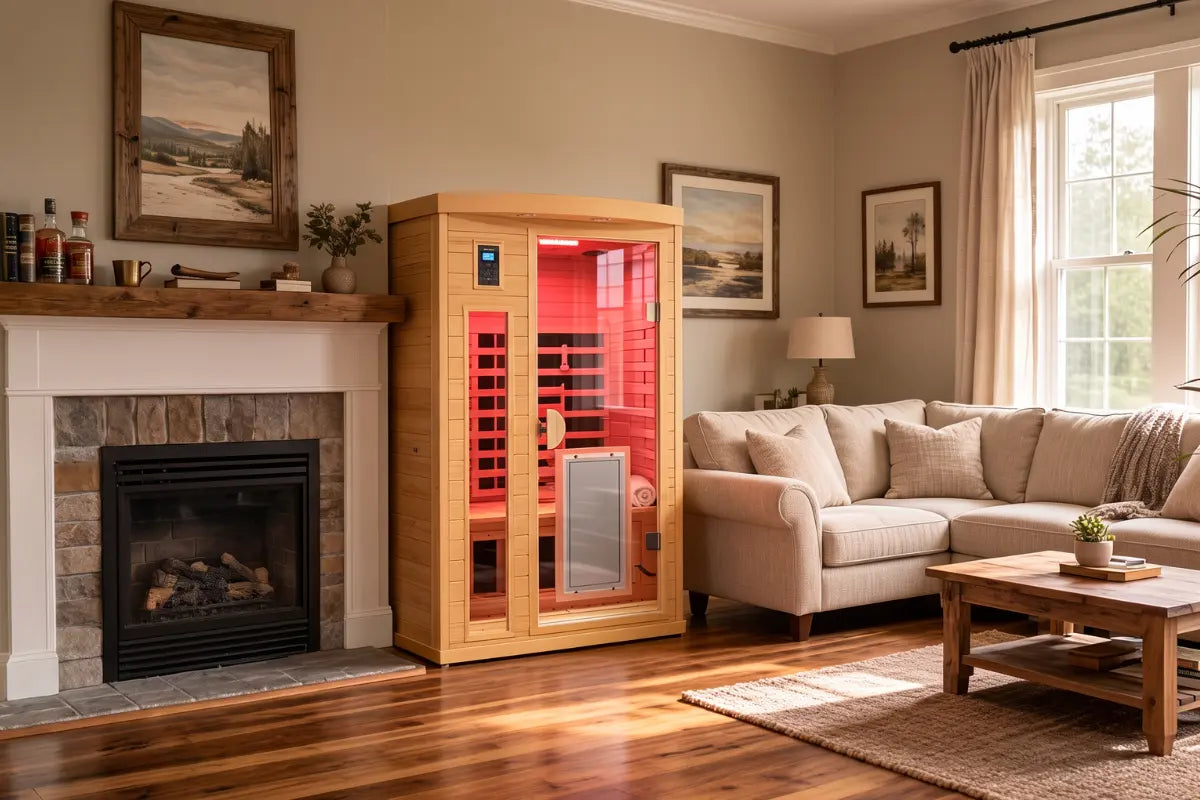
Here's a question we hear almost every week: "We want a sauna at home — just for the two of us. Why is this so hard to choose?"
It's a fair complaint.
Search for a 2-person infrared sauna and you'll drown in options: $899 mystery cabins next to $6,000 showroom models, all using the word "premium," all claiming to be the best. The most popular sauna size in America also happens to be the most confusing to buy.
So this guide skips the fluff.
What "best" genuinely means for a cabin that lives in your home. What the red light trend actually does for your body. And the five questions that quietly eliminate most of the market. By the end, choosing won't feel like research anymore. It'll feel like a decision.
For home use, "best" rarely means biggest or most expensive. It means the cabin fits your room, plugs into your existing outlet, heats you evenly from every side, and feels good enough that you actually use it four nights a week.
The 2-person size wins for one simple reason: it's the smallest cabin where two adults can sit comfortably — and shared sessions are the ones people stick with.
Why Two-Person Is the Sweet Spot for Home
Watch how these cabins actually get used, and a pattern shows up fast.
Solo buyers of 1-person cabins usually love them — then mention, a year in, that they wish they'd sized up. Owners of big 3 and 4-person cabins often admit they sit in them alone, heating a room's worth of air they don't need.
The 2-person sits right in the middle of that regret curve.
Room for you and a partner, a parent, a training buddy. Room to stretch your legs when it's just you. Small enough for a spare bedroom corner or a home gym. And because the cabin is compact, it heats up faster and costs less to run than its bigger siblings.
There's a quieter reason too, and it comes up constantly in owner communities: shared habits survive.
A solo wellness gadget is easy to skip when the day runs long. A standing date — twenty-five minutes, no screens, just heat and conversation — is something two people keep for each other.
The Checklist That Actually Matters at Home
Forget the marketing checklist.
Here's the homeowner's version — five questions, each grounded in how these cabins behave after the delivery truck leaves.
| Question | Why It Matters at Home | What Good Looks Like |
|---|---|---|
| Will it fit — really? | Delivery-day surprises are the number one regret in owner forums | Measure the room, the doorways, and the stairwell turns; leave a few inches of breathing room on each side |
| Does it plug into a normal outlet? | A 240V requirement can mean an electrician visit before your first session | Most quality 2-person cabins run on a standard 120V household outlet — confirm on the spec sheet |
| Does the heat wrap around you? | Panels only on the back wall leave your front cold and your sessions short | Heaters on multiple walls, calf-level coverage, no "cold corners" |
| Are the EMF numbers published? | You'll sit inches from those panels four nights a week | Documented milligauss readings at seated position — a number, not an adjective |
| Who answers in year two? | Heaters and controls are the parts that eventually need support | A named warranty on heaters and electrical, from a company that sells its own builds |
Do the "doorway walk" before you buy: tape measure in hand, from your front door to the room where the cabin will live, checking every turn. Sauna panels ship flat and assemble on site, so they're far easier to move than furniture — but knowing your clearances turns delivery day from a gamble into a formality.
Most 2-person cabins go up in an afternoon with two adults and no special tools.
The Red Light Question Everyone's Asking
Open Instagram or TikTok and red light therapy is everywhere — athletes in front of glowing panels, skincare creators swearing by it, recovery routines built around it.
So naturally, sauna buyers have started asking: should my sauna have it built in?
Here's the honest version.
Red and near-infrared light, delivered at specific wavelengths, has been studied for its effects on skin and soft tissue. The research keeps pointing in a few consistent directions: support for circulation in the skin, help with the appearance of fine lines and skin tone over time, and a role in muscle recovery after training — which is why so many athletes pair it with heat.
It's not magic, and it isn't medicine. But it isn't hype either.
And here's the practical part: a sauna session is already the perfect setting for it. You're sitting still. You're relaxed. Your skin is warm, your circulation is up. A red light panel built into the cabin turns one habit into two — same 25 minutes, same ritual, an extra layer of benefit you never have to schedule separately.
If you're curious how light and heat do different jobs, our explainer on near infrared versus far infrared breaks it down in plain terms.
Where the Maxwell-902BHN Earns Its Spot
Run that checklist against our catalog, and one model checks every box — which is exactly why it's the cabin we point 2-person buyers toward: the Maxwell-902BHN 2-Person Ultra-Low EMF Far Infrared Sauna.
Start with the everyday realities.
It's sized for two adults to sit comfortably — genuinely comfortably, not elbows-tucked comfortably — on a footprint that fits a spare room corner. The ultra-low EMF heater array wraps the cabin in even, all-around far infrared warmth, with documented readings as low as 0.5 mG. That's a number you can verify, not just read about.
And the integrated red light therapy panel means the skin-and-recovery benefits described above come built into the session. No second device cluttering the room.
Then there's the ownership side.
The 902BHN is rated 4.9 stars across 96 verified owner reviews — the kind of score you only get when delivery, assembly, and year-two support all hold up. It starts at $2,299, with factory-direct pricing doing what it always does: money into heaters and wood, not showroom margins.
Every cabin carries a 2-year warranty on heaters and electrical and a 1-year warranty on the wood, with optional extensions if you'd like longer coverage. The full line is on our Maxwell series page, and our 2026 cost breakdown shows how it stacks up against the wider market.
If your space or budget points smaller, the guide to choosing an infrared sauna under $2,000 compares six models in five minutes. Dreaming about the backyard instead of the spare room? The outdoor sauna guide is your next read.
Frequently Asked Questions
Is a 2-person infrared sauna big enough for two adults?
In a well-designed cabin, yes — two average adults sit side by side comfortably with room to lean back. If either of you is well over six feet or prefers stretching out solo, check the bench length and interior width on the spec sheet first.
How much space do I need for a 2-person sauna at home?
Think large armchair: roughly a 4-by-4 foot corner, plus a few inches of clearance on each side for airflow. A spare bedroom corner, home gym, or generous closet usually works. Measure your doorways for delivery day.
Does a 2-person infrared sauna need special wiring?
Usually not. Most quality 2-person models run on a standard 120V household outlet, like a hairdryer. Larger 3 to 4-person cabins sometimes need a dedicated 240V line — always confirm on the spec sheet before buying.
What are the benefits of red light therapy in a sauna?
Red and near-infrared light has been studied for skin support — circulation, tone, the appearance of fine lines over time — and for muscle recovery after exercise. Built into the cabin, it layers those benefits onto the session you're already taking, with no extra time or device required.
How long does a 2-person sauna take to heat up?
Typically 15 to 25 minutes from power-on to full temperature, depending on the room it's in. Most owners tap the button before changing clothes and step into a fully warmed cabin. Start your session timer when you step in, not when you switch it on.
How much does a good 2-person infrared sauna cost?
The dependable range in 2026 runs roughly $1,500 to $3,500 from factory-direct brands, with premium showroom models reaching $6,000 or more. At the same build quality, factory-direct pricing typically saves 40% or more by removing dealer markup.
Is a 2-person sauna worth it if I'll mostly use it alone?
For most solo users, yes. The extra bench room makes sessions noticeably more comfortable — you can shift positions, stretch your legs, and recline properly. The trade-offs versus a 1-person are a slightly larger footprint and a few extra minutes of preheat.
We started in 2004, building our earliest products with a medical device engineering sensibility — measure everything, publish what you measure, and design around how people actually live.
The 2-person cabin is where that philosophy shows most clearly, because it's the size where comfort, efficiency, and real life all have to fit in the same room.
The Maxwell-902BHN is our answer for home buyers: ultra-low EMF heaters tested as low as 0.5 mG, even wraparound warmth, an integrated red light therapy panel, and a 4.9-star rating from 96 verified owners — at factory-direct pricing that skips the showroom markup entirely. Explore the range at salusheat.com/collections/ultra-low-emf-saunas.
- Designed for real homes: standard-room footprints, household power, two-adult assembly
- Ultra-low EMF engineering, tested and documented — readings as low as 0.5 mG
- Integrated red light therapy options in the Maxwell series
- 4.9-star rated across 96 verified owner reviews on the Maxwell-902BHN
- 2-year warranty on heaters and electrical, 1 year on the wood, with optional extensions
The best home sauna is the one that turns "we should do this more often" into a standing appointment.
This article is for informational purposes only and does not constitute medical advice. Research into red light therapy is ongoing, and individual results vary. If you have specific health conditions or concerns, please consult your physician before beginning any new wellness routine.
