
What First-Time 2-Person Sauna Buyers Actually Ask
We keep a running joke on our support line: if you call us about a two-person sauna, we can usually guess your next question before you ask it. The order barely ever changes.
And it's never the order the spec sheets are written in.
Ellen, a customer of ours in Ohio, spent four months researching before she finally called. Eleven browser tabs, a spreadsheet, a folder of screenshots. Her husband had already staked out his position, and it was not a subtle one: "We'll use it twice and then it'll be a very expensive coat rack."
Her first question to us wasn't about panels or wood or price. It was this: "Be honest with me — will we actually use this thing?"
That's the question underneath all the others, and it's the one no product page ever answers. So this is that conversation, in the order it actually happens: what first-time two-person buyers really want to know, and the honest answer to each one — including the parts that took Ellen's husband three weeks to admit.
First-time buyers almost never regret spending too little on panels. They regret buying a cabin that was slightly uncomfortable to sit in — because an uncomfortable sauna is the only kind that actually turns into a coat rack.
Comfort, not technology, is what decides whether you're still using it in month three. That single fact should reorganize your whole shortlist.
The Questions Come in the Same Order
Here's the sequence, from hundreds of these calls. If you've been circling a purchase for weeks, you'll probably recognize yourself somewhere on this list.
- "Will we actually use it, or is this going to sit there?"
- "Will it feel hot enough — or will my front be cold?"
- "Where would it even go in our house?"
- "What does it really cost to own — not just to buy?"
- "What if we get it and regret it?"
Notice there's nothing on that list about heating technology, heater count, or wood species. Those are real questions, but they're the second layer. They arrive after the anxiety is settled. Let's take them in the order people actually feel them.
Question 1: "Will we actually use it?"
We answer this one the same way every time: yes, if you set it up so that the decision is already made for you.
The owners who use their cabin four nights a week are not more disciplined than you. They've simply removed the moment where they'd have to choose. The sauna lives in a room they already walk through. The preheat button gets tapped on the way past. The water bottle already sits by the door. By the time anyone asks "should we?", the cabin is warm and the question is moot.
The owners who stop using theirs did something different, and it's almost always the same mistake: they put it somewhere inconvenient but tidy. The far end of the basement. The guest room nobody enters. A garage that requires shoes and a jacket in February. Every session became a small expedition, and small expeditions lose.
There's a second half to this answer, and it matters more than placement.
Nobody repeats a session they endured.
If your 20 minutes feel like something to get through — too hot, too cramped, cold on one side, elbows tucked — you'll find reasons not to go back, and they'll all be perfectly reasonable reasons. Which leads directly to the next question.
Question 2: "Will it feel hot enough — or will my front be cold?"
This is the question that separates a good two-person cabin from a merely presentable one, and almost nobody asks it out loud. They just feel it on day one, and quietly feel let down.
Here's what's happening. On most infrared cabins, the heaters live on the back wall and the two side walls. The front is the glass door — and on a lot of models, that door is just glass. Nothing heats it. So the panels warm your back and your shoulders beautifully while your chest and your shins sit in front of a cold pane.
Your body registers the imbalance immediately: you're sweating and chilly at the same time, and you end up sitting sideways, hunched forward, rotating like something on a rotisserie.
Fixing it means putting a heating panel inside the door. It costs the manufacturer real money, it complicates the assembly, and it's invisible in a product photo — which is exactly why so many brands don't bother. You won't read it on a spec sheet. You'll only notice it by looking at a cabin and counting where the heat actually comes from.
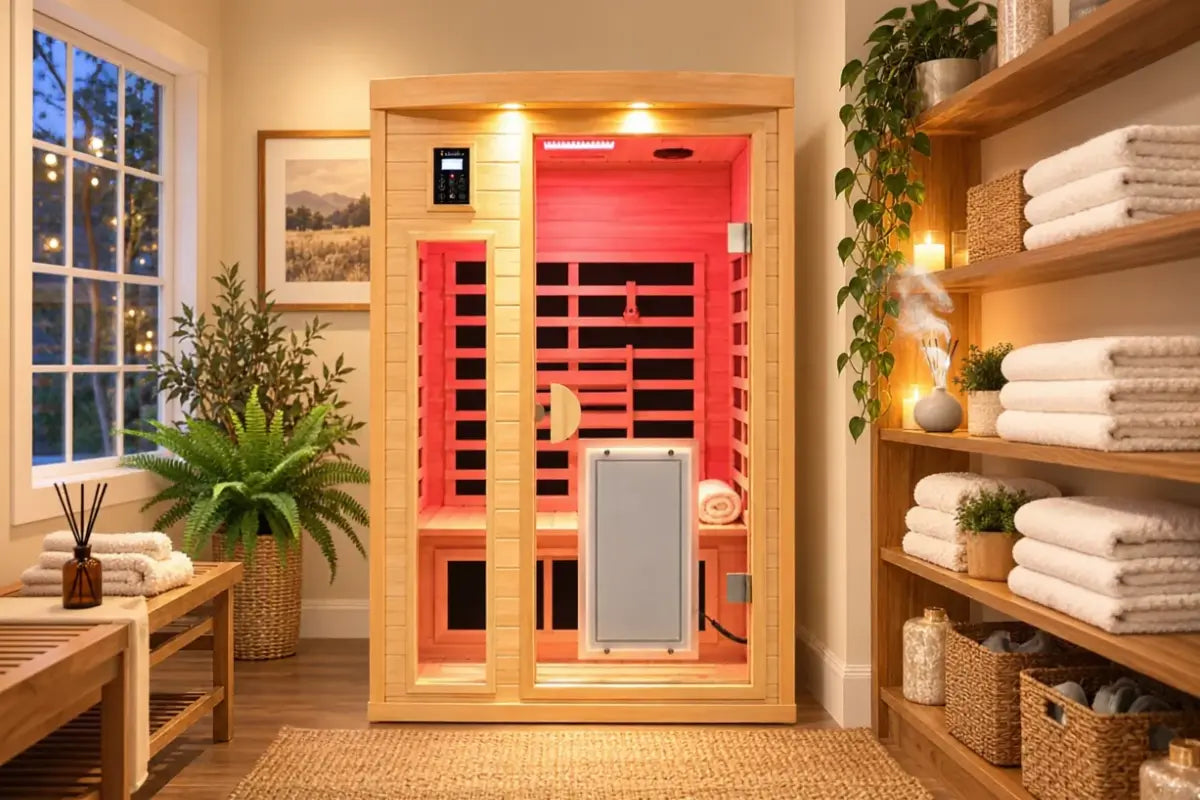
This is the specific reason we point two-person buyers toward the Maxwell-902BHN. It carries nine heating panels — more than any other indoor sauna we build — with large carbon panels covering all four walls, including a heated front door glass. The result is a full 360-degree envelope: back, sides, front, and even the calf-level run along the floor. You sit in warmth instead of in front of it.
| What You Feel | Typical 2-Person Cabin | Purity-902CH |
|---|---|---|
| Where the heat comes from | Back wall and two side walls | All four walls, in a 360° surround |
| The front door | Unglazed thermal weak point — cold against your chest and shins | Heated glass panel built into the door frame |
| How it feels sitting still | You rotate, lean forward, chase the heat | You sit back against the rear panel and stay there |
| Session length you'll actually keep | Short — you leave when the cold side wins | The full 20–30 minutes the benefits come from |
That last row is the whole point, and it's worth saying plainly: the reason panel coverage matters isn't luxury. It's that a cabin you can sit still in is a cabin you'll sit in for the full session — which is where every benefit you bought the thing for actually lives.
When you tour any cabin — ours included — sit in it and count the panels by feel, not by sight. Close the door, sit back, and notice where your body registers cool air.
Chest, shins, and the top of your head are the three spots cheap cabins neglect. A two-person cabin should feel warm in all three before you buy it.
Question 3: "Where would it even go in our house?"
The unglamorous answer: the two-person size is the most forgiving size in the category, and almost every home has a spot if you measure honestly first.
Before you commit, do the walk. Measure the room you have in mind, then measure the path from your front door to that room — every hallway width, every doorway, every turn at the top of a staircase. These cabins ship flat and assemble on site, so they're far easier to move than furniture, but knowing your clearances in advance turns delivery day from a gamble into a formality. Then confirm two things on the spec sheet: the exact assembled footprint (including roof overhang) and the outlet requirement for your model. A two-person indoor cabin usually runs on ordinary household power, and checking rather than assuming saves you an electrician visit you didn't plan for.
The placement that works best in most homes is dull and unromantic: the spare bedroom, the finished basement corner, the home office that's really a gym with a desk in it. Somewhere you already walk past. If you want the fuller decision framework — size, capacity, and which of these cabins suits which household — our guide to the best 2-person infrared sauna for home covers it properly.
Question 4: "What does it really cost to own?"
Everyone fixes on the sticker price. The number that actually surprises people is the monthly cost of running one — and it surprises them pleasantly.
A two-person infrared cabin draws power the way a hair dryer does, from a standard outlet. At average US electricity rates, a 30-minute session costs roughly 20 to 30 cents. Use it five nights a week and you're looking at a few dollars a month. Compare that with the alternative most buyers are quietly weighing: a studio session runs $30 to $60. Even a modest home cabin pays for itself against that habit inside a year.
The costs worth seeing coming are the small ones nobody itemizes: delivery placement, an afternoon of two-person assembly, and — if you want a dedicated circuit for peace of mind — an electrician's visit. None of these are large. All of them are easier when you've budgeted for them before they arrive.
Question 5: "What if we get it and regret it?"
This is the honest fear behind the other four, and it deserves an honest answer: the real protection isn't in a slogan. It's in three concrete things.
First, who stands behind the parts that eventually fail. Heaters and electrical are the components that need support in year three, so ask what the warranty covers on those specifically — not on "the product." Ours is a two-year warranty on heaters and electrical and one year on the wood, with optional extensions if you want longer coverage.
Second, who answers the phone. The reason we sell factory-direct is that there's no retail layer between you and the people who built the cabin, so a question in month eight reaches someone who actually knows the answer.
Third, and most useful: buy the cabin you'd still choose if you never had a reason to call anyone. Everything above — the 360-degree panel coverage, the honest footprint, the outlet that's already there — is really about a single idea. A sauna that feels good on a random Tuesday doesn't need defending.
The First Thirty Days, Honestly
We ask every customer to check back after a month, which means we hear what those first weeks actually feel like. The pattern is so consistent that we can describe it almost to the day.
Week one: the novelty, and a small overcorrection. Almost everyone overdoes it — six or seven sessions in the first several days, then a night of sleeping like a stone. Some people start announcing it to friends before anyone asked. This week is fun and it means nothing yet.
Week two: the real test. The novelty is gone and a bad week arrives — a work deadline, a kid's schedule, a cold. This is the week that decides everything, and it's the week our advice about inconvenience pays off. If the cabin is in the room you pass through, you'll take one short session on a night you didn't feel like it, and the habit survives. If it's down two flights of stairs, this is the week it doesn't.
Week three: the shift. Something quietly changes. Sessions stop being an event you schedule and become a thing you do — the way you don't "decide" to brush your teeth. You start noticing the difference on the nights you skip, which is a stronger motivator than any benefit anyone could describe to you.
Week four: it becomes furniture in the best way. It's simply part of the house now. And this is where Ellen's story turned, because her husband — the man with the coat rack prediction — became the person who preheats it before she gets home.
Nobody was more surprised than he was. Which is roughly how it goes with the skeptics.
The Bottom Line
If you're the person with eleven tabs open, worried about the coat rack: you're asking the right question, and the answer isn't a matter of willpower. It's a matter of buying a cabin you'll genuinely want to sit inside, and putting it somewhere you already walk. Get those two things right and the habit takes care of itself.
And when it comes to sitting inside it, panel coverage is the spec that decides whether you're comfortable or merely warm — which is why the 902CH carries nine panels and a heated door, and why we'd rather you count them in person than take our word for it. If you want to know how long each of those sessions should run once the cabin is in your house, our guide to how long to stay in an infrared sauna is the natural next read.
Frequently Asked Questions
Is a 2-person infrared sauna big enough for two adults to be comfortable?
In a well-designed cabin, yes — two average adults sit side by side with room to lean back against the rear panel. If either of you is well over six feet, check the bench length and interior height on the spec sheet before deciding between sizes.
How many heating panels should a 2-person infrared sauna have?
Enough to surround you. Back-and-side-wall coverage leaves the front of your body cool; nine panels across all four walls — including the door — is what produces a 360-degree envelope so you can sit still for the full session instead of rotating to chase heat.
Why does a heated front door matter?
Because the door is the front of your body. On cabins with unheated glass doors, your chest and shins sit against a cold pane while your back sweats — the most common reason people cut sessions short. A panel built into the door closes the gap in the heat envelope.
Where should I put a 2-person sauna in my house?
Somewhere you already walk past daily — a spare bedroom, finished basement corner, or home gym. Convenience decides long-term use more than any other factor. Measure the room, doorways, and stairwell turns before purchase, and confirm the assembled footprint and outlet requirement on the spec sheet.
How much does it cost to run a 2-person infrared sauna?
Roughly 20 to 30 cents per 30-minute session at average US electricity rates. Five sessions a week lands in single-digit dollars per month — a fraction of what studio sauna sessions cost.
How long does a 2-person infrared sauna take to heat up?
Typically 15 to 25 minutes from power-on to full temperature at a comfortable indoor room temperature. Most owners press the button before changing clothes, then step into a fully warmed cabin and start their session timer at the door.
What if I'm worried we won't use it enough?
That fear is reasonable, and it's mostly solved by two decisions made before delivery: choosing a cabin that's genuinely comfortable to sit in, and placing it where you already spend time. Our warranty covers heaters and electrical for two years and the wood for one, with optional extensions — and if the worry persists, buy the size you'll actually fit in daily rather than the biggest one that fits your budget.
We've been building heating products since 2004, and the Purity-902CH is our answer to a complaint we heard for years: two-person cabins that look right in photos and feel wrong after ten minutes. Nine heating panels, carbon coverage on all four walls, and a heated front door glass — the parts of the build that never show up in a product picture are exactly the parts that decide whether you keep using it.
Because we sell factory-direct, that engineering lands at $1,999 rather than a showroom price, backed by a two-year warranty on heaters and electrical and one year on the wood, with optional extensions available. Explore the full range at salusheat.com/collections/all-products.
- Nine large carbon heating panels — full 360-degree coverage across all four walls
- Heated front door glass, a detail most two-person cabins leave out
- Two-person interior sized for sitting back, not perching forward
- Factory-direct pricing at $1,999, no showroom markup
- Two-year warranty on heaters and electrical, one year on the wood, optional extensions
The best test of a sauna isn't how it looks in the showroom. It's whether you're still sitting in it on a Wednesday in month three.
Somewhere out there is someone with eleven tabs open who needs exactly the answer you wish you'd had.
This article is for informational purposes only and does not constitute medical advice. Product specifications, footprint, and electrical requirements vary by model and should be confirmed on the product spec sheet before purchase. Local electrical and permit requirements should be verified with qualified professionals.
