
Why Recovery Is Becoming More Important Than Performance
For a long time, the conversation around health focused on one thing:
Performance.
How productive are you.
How hard do you train.
How many hours do you work.
How much can you accomplish in a single day.
The underlying message was always the same:
Do more.
Push harder.
Stay ahead.
But something interesting has started happening over the past few years.
More people are beginning to realize that performance is only half of the equation.
Because no matter how strong, motivated, or disciplined a person may be, the body and mind still need time to adapt, recover, and reset.
Without recovery, performance eventually becomes difficult to sustain.
And that realization is quietly changing how an entire generation thinks about wellness.
Key Insight
Modern wellness is shifting away from asking: "How much weight did I lose?" and toward asking: "How well is my body recovering?"
Perhaps the distinction between these two questions is becoming one of the defining health conversations of the next decade.
The Problem With Being "Always On"
Notifications begin before the coffee is ready.
Screens stay lit long after the day is over.
Work follows people home.
Phones travel everywhere.
Even relaxation often becomes another form of stimulation — another feed, another inbox, another track to finish.
Many people now live in a constant cycle of:
- work
- exercise
- errands
- family obligations
- social commitments
- digital distractions
Individually, none of these things are harmful. The challenge is that very few of them create space for genuine recovery.
The body is remarkably capable of adapting to stress. But adaptation only happens when periods of challenge are balanced with periods of restoration.
Without that balance, many people begin feeling:
- mentally exhausted
- physically tense
- emotionally drained
- unable to fully relax
Not because they are doing something wrong.
But because they never truly stop.
What Is Adaptive Recovery?
Adaptive recovery is the body's ability to return to balance after periods of stress, activity, or mental demand.
Consider exercise for a moment. Muscles do not become stronger during a workout. They become stronger during recovery — when the body repairs, rebuilds, and adapts to the demand it has just experienced.
The same principle applies across nearly every dimension of daily life.
Clarity of thought.
Emotional regulation.
Sustained focus.
Consistent routines.
None of these are built on effort alone. All of them depend on recovery as an active, intentional process.
This is why many wellness professionals now describe recovery not as the absence of work, but as a deliberate practice that supports adaptation.
Recovery is not what happens after the work is finished. It is the work that makes the next effort possible.
Why More People Are Creating Recovery Rituals
One of the most noticeable shifts in wellness today is the rise of recovery rituals — small, repeatable practices that help people transition out of high-stimulation environments and into a more restorative state.
Examples now appear everywhere:
- evening walks
- meditation
- stretching
- breathwork
- reading
- sauna sessions
What these practices share is not a specific technique. It is the quality of pause they create.
They give the body a clear signal: the period of demand has ended, and the period of restoration can begin.
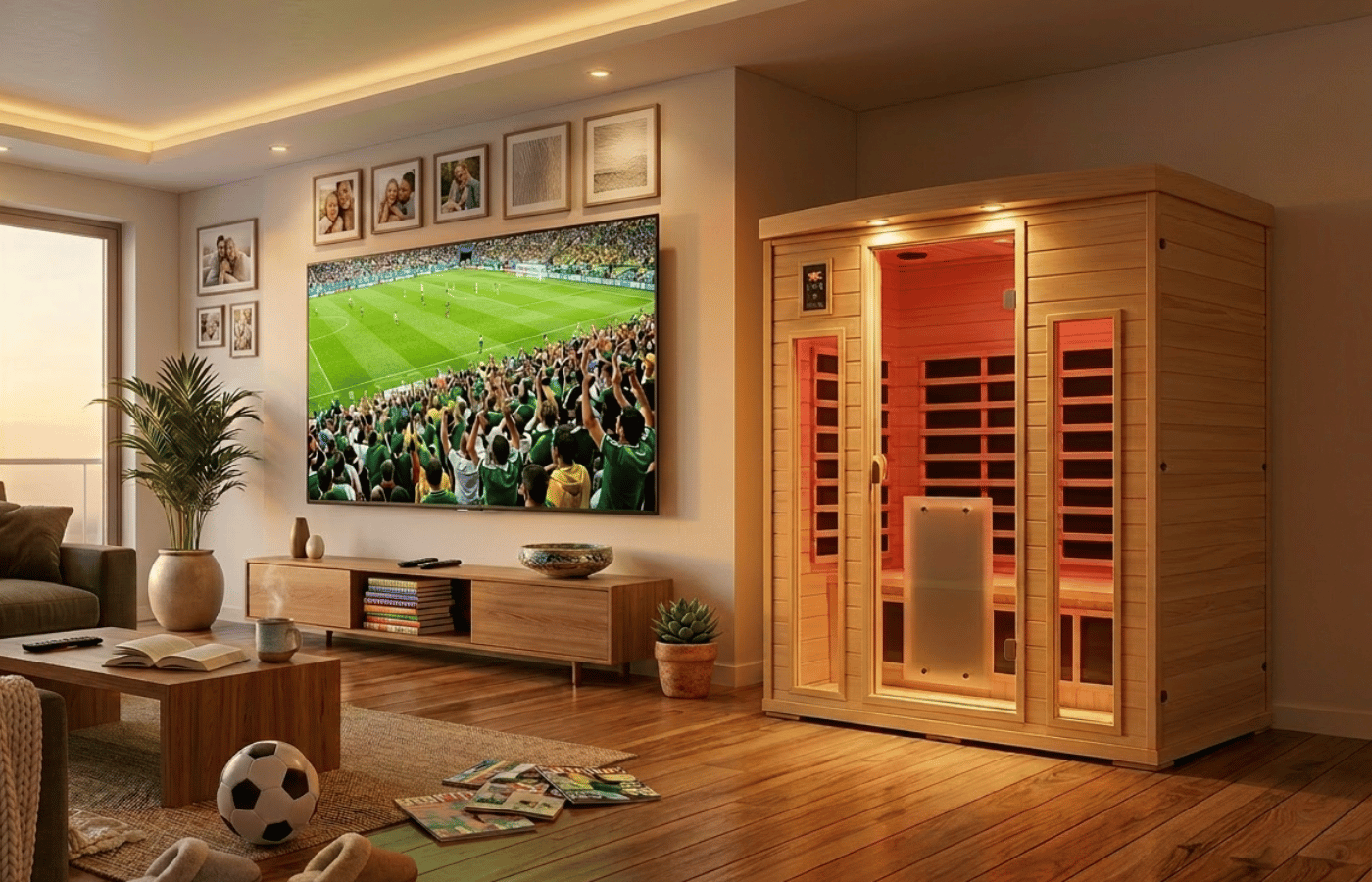
For many homeowners, an infrared sauna has become part of that transition — not because it feels luxurious, but because it creates a dedicated space where recovery becomes the entire focus.
Why Rituals Work
Recovery rituals are effective not because of any single physiological effect, but because they consistently tell the nervous system that it is safe to step out of "do" mode. That signal — repeated often enough — is what allows recovery to become a habit rather than an occasional indulgence.
What if the biggest threat to long-term health isn't visible on the scale?
Why Infrared Saunas Fit Naturally Into Recovery-Focused Lifestyles
One reason infrared saunas continue to gain popularity is that they encourage people to slow down.
Unlike many wellness practices built around doing more — another workout, another metric, another optimization — a sauna session asks the opposite.
You sit.
You breathe.
You disconnect.
You allow your body to settle.
For many people, this may be one of the few moments in the day when there are no notifications, deadlines, or expectations competing for attention.
Over time, that experience becomes surprisingly valuable — not because the sauna itself is doing something extraordinary, but because the routine surrounding it rewires how the day ends.
The sauna is part of the equation. The ritual is the other part.

Recovery Is Not About Doing Less. It Is About Sustaining More.
One of the most persistent misconceptions about recovery is that it represents weakness, laziness, or lack of discipline.
In practice, the opposite is closer to the truth.
Recovery is what makes long-term consistency possible.
Professional athletes understand this.
Elite performers understand this.
Sustainable routines are rarely built on constant intensity. They are built on cycles of effort and restoration that can be repeated for years.
The goal is not to avoid challenge. The goal is to remain capable of meeting challenges again tomorrow.
The strongest routines are not the most intense ones. They are the ones that can be repeated.
Traditional Wellness vs. Emerging Wellness
| Traditional Wellness | Emerging Wellness |
|---|---|
| Performance Output | Recovery Capacity |
| Exercise Volume | Sleep Quality |
| Calories Burned | Stress Resilience |
| Productivity | Longevity |
| Short-Term Results | Sustainability |
| Appearance | Energy Levels |
The shift reflected in this table is not a rejection of results. It is a reorientation toward outcomes that compound over time — outcomes built on consistency, recovery, and the quality of daily habits rather than the intensity of any single intervention.
Research Snapshot
Major medical organizations have begun to discuss heat exposure, sauna use, and recovery-oriented practices as part of broader wellness routines — though the evidence base is still developing.
The Mayo Clinic has discussed the physiological responses associated with infrared sauna use, including increased heart rate and sweating, while emphasizing that long-term studies are still ongoing and that individual results may vary.
Cleveland Clinic has highlighted potential benefits related to stress reduction, cardiovascular health, muscle recovery, and sleep quality, while also noting that further research is still needed before definitive conclusions can be drawn in several areas.
Harvard Health Publishing has frequently discussed the importance of recovery habits, sleep, and lifestyle consistency as meaningful components of healthy aging — framing them as sustainable practices rather than short-term interventions.
Importantly: None of these organizations describe sauna use as a replacement for exercise, nutrition, sleep, or medical treatment. Instead, sauna sessions are increasingly viewed as one part of a broader wellness strategy built around sustainable habits and recovery.
Why SalusHEAT Designs for Long-Term Wellness
The SalusHEAT Perspective
At SalusHEAT, we believe the most valuable wellness products are the ones that fit naturally into everyday life. Not products that are used once and forgotten. But environments people genuinely return to, week after week and year after year.
That philosophy influences every design decision we make, including:
- Ultra-Low EMF engineering
- Full-spectrum infrared heating
- Premium natural wood construction
- Spacious interiors designed for extended sessions
- Ergonomic layouts suited to everyday use
- Long-session usability for repeatable, sustainable routines
Because the best wellness routine is not the most extreme one. It is the one you can sustain.
Final Thoughts
Modern culture continues to celebrate performance.
But increasingly, people are beginning to understand the deeper value of recovery.
Not as a reward for hard work.
Not as an afterthought once the day is over.
But as an essential part of living well.
Because the goal was never simply to push harder.
The goal is to remain healthy, capable, and resilient over the long term.
The future of wellness may not belong to those who can push the hardest. It may belong to those who recover the best.
Frequently Asked Questions
What is adaptive recovery?
Adaptive recovery refers to the body's ability to restore balance and adapt following periods of physical, mental, or emotional stress. It is increasingly discussed in wellness research as an active process rather than a passive outcome.
Why is recovery important for overall wellness?
Recovery supports consistency, resilience, mental clarity, and the body's ability to adapt to daily demands. Wellness routines that ignore recovery often produce short-term results that are difficult to sustain over time.
How do infrared saunas fit into recovery routines?
Many people use infrared sauna sessions as part of intentional recovery rituals. The combination of warmth, stillness, and reduced stimulation is often described as a useful way to transition out of a high-demand day.
Why are more homeowners creating wellness spaces at home?
Convenience is one of the strongest predictors of habit. Home wellness spaces make it easier to prioritize recovery, relaxation, and sustainable routines without depending on appointments, commutes, or external schedules.
Where can I learn more about infrared sauna usage?
If you have additional questions about infrared saunas, installation, or daily use, you can visit the SalusHEAT FAQ page for detailed answers to the most common sauna questions. You can also explore the full range of SalusHEAT infrared saunas at the all-products collection.
References
- Mayo Clinic — Do infrared saunas have any health benefits?
- Cleveland Clinic — Get Your Sweat On: The Benefits of a Sauna
- Harvard Health Publishing — Can regular sauna sessions support a healthy heart?
- University of Eastern Finland — Sauna bathing research
