
Low EMF Infrared Sauna Technology: Maxwell Series Real Test Data
In Reddit's infrared sauna communities, EMF consistently ranks as one of the top five purchase concerns — and users there aren't satisfied with vague marketing copy. They want milligauss numbers, testing methodology, and evidence that a brand has actually engineered for low EMF rather than just labeling their product that way.
This article goes into the actual technology and test data behind near-zero EMF infrared saunas — what the measurements mean, how the engineering works, and what real-world numbers look like across the Maxwell BHN lineup.
What Is EMF in Infrared Saunas
EMF — electromagnetic field — is produced whenever electrical current flows through a conductor. In an infrared sauna, that means every heating element, every wire run along the wall panels, and the control circuitry all generate a surrounding electromagnetic field while the unit is operating.
The reason this matters more in a sauna than in, say, a standard household appliance is proximity and duration. A user is seated inches from multiple heating panels continuously for 20 to 40 minutes per session. Distance reduces EMF intensity exponentially — so being close to the source for an extended period is meaningfully different from casual proximity to a lamp or television.
EMF exposure in a sauna is a proximity-and-duration issue, not just a power issue.
How EMF Is Actually Measured
The standard unit for measuring magnetic field strength in consumer contexts is the milligauss (mG). One mG is one-thousandth of a gauss — it is a measurement of magnetic flux density at a given point. Consumer-grade Gauss meters (also called EMF meters) measure this at the panel surface, typically at 2–4 inches distance.
The industry uses terms like "low EMF," "ultra-low EMF," and "near-zero EMF" without a shared standard. A product labeled "low EMF" by one brand might read at 30 mG; another brand's "ultra-low" might be 8 mG. Without a publicly stated milligauss figure, the label carries no quantifiable meaning.
This is a significant transparency problem across the category. Many sauna brands operating in the mid-range market have panels that test well above 100 mG at operating distance — a figure most informed buyers consider unacceptably high for a daily-use wellness product.
Without a meter, "low EMF" is just a label. Real numbers in mG are the only thing that counts.
The Patented Near-Zero EMF Technology
The core engineering principle behind this technology is called electromagnetic wave phase dislocation cancellation. In plain language: the panel heaters are engineered so that two opposing electromagnetic wave phases are precisely aligned to cancel each other out. Rather than shielding the field after it has been generated, the design eliminates it at the source.
This approach is fundamentally different from conventional EMF reduction strategies, which typically involve conductive shielding materials applied around existing heater assemblies. Shielding attenuates; phase cancellation neutralizes. The distinction matters because shielding degrades over time and is highly direction-dependent, while phase cancellation is inherent to the heater's electrical architecture.
Development of the ultra-low EMF carbon panel heaters used in this technology began in 2010, with over a decade of iteration before the patent was filed and granted.
EMF Test Data Across the BHN Lineup
The same patented phase-dislocation cancellation technology is applied identically across every model in the Maxwell BHN series. The heater panel design, electrical architecture, and EMF engineering do not change based on cabin size — so consumers are not trading safety performance for space or capacity.
Measured at operating panel distance, all three models deliver the same near-zero output:
All three models use identical patented near-zero EMF technology — EMF performance is consistent regardless of size.
Why Low EMF Matters & What Direction to Choose
For anyone using an infrared sauna on a daily or near-daily basis, cumulative exposure reduction is the practical argument. A single session at 100+ mG versus a single session below 0.5 mG is a 200-fold difference per use — and over months of regular use, that gap is substantial regardless of where ongoing research settles on safe thresholds.
Near-zero EMF is also shifting from a premium differentiator to an expected category baseline. As consumer awareness of milligauss measurement grows — and as basic EMF meters have become inexpensive and widely available — buyers are increasingly verifying claims independently. Brands without documented test data are losing credibility in informed communities.
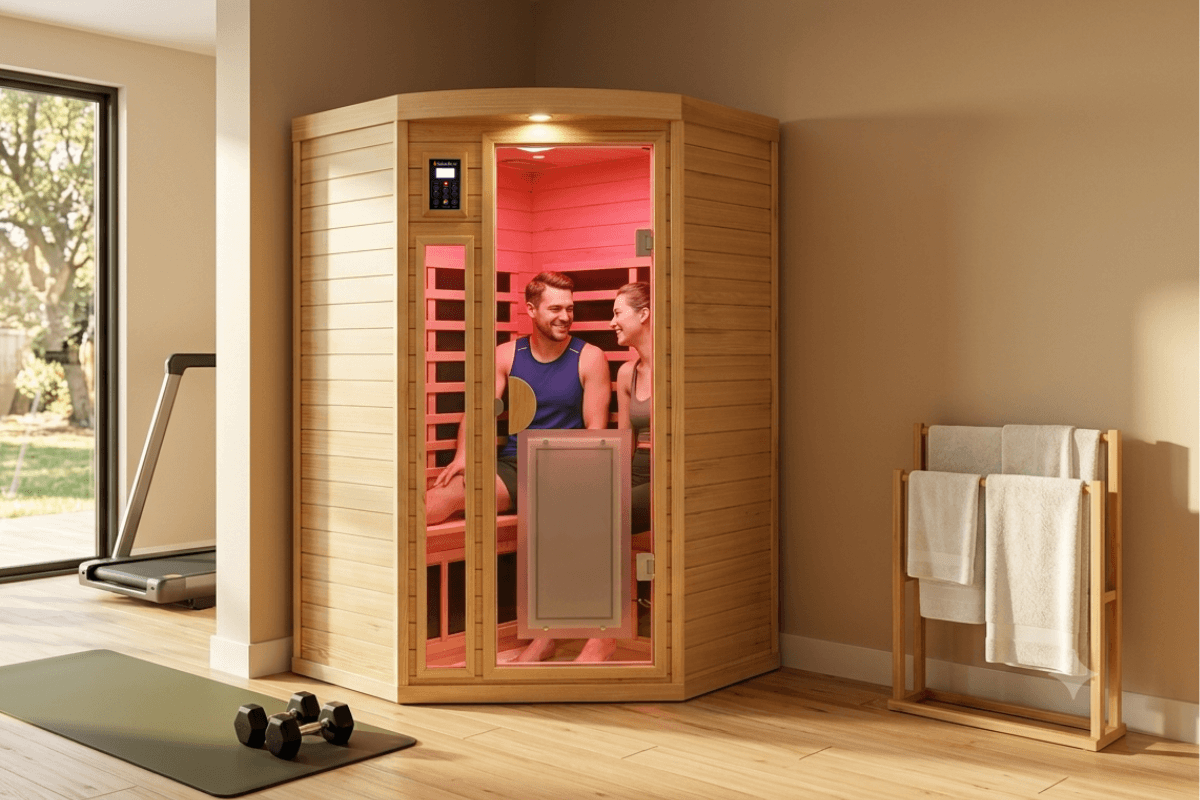
The 901BHN, 902BHN, and 907BHN deliver identical near-zero EMF performance. The selection decision comes down purely to space and intended capacity: single-person use, two-person use, or a corner-format two-person configuration. No model requires a compromise on EMF safety.
If you are unsure about the numerical values, you can consult <The EMF Values of Infrared Saunas: Low EMF and Low ELF>.
Choose by your space and capacity needs — all three deliver the same near-zero EMF safety. No compromise.
Frequently Asked Questions
-
What is a safe EMF level for an infrared sauna?
Below 1.0 mG is considered near-zero; SalusHeat BHN models average below 0.5 mG.
-
What does "near-zero EMF" actually mean?
EMF readings in the 0.1–1.0 mG range — engineered through phase cancellation, not just shielding.
-
Can I measure EMF myself?
Yes — a basic EMF meter (Gauss meter, $20–50) can take readings at the panel surface during operation.
-
Do all SalusHeat saunas use the same EMF technology?
The Maxwell, Ample, and Wearwell lines all use the same patented phase-dislocation cancellation technology.
