
Infrared vs Traditional Sauna: The Truth You Need to Know
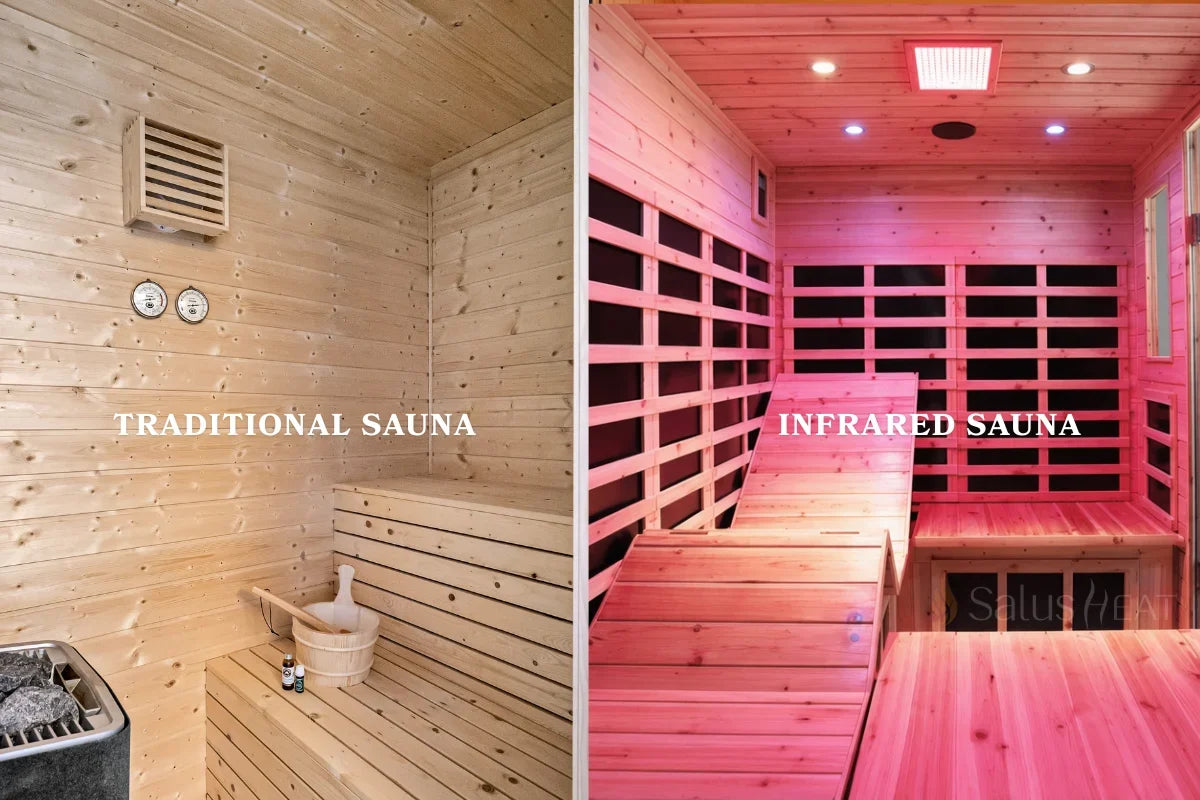
There's a question our support line fields almost daily, usually from someone holding two browser tabs open at 10 p.m.: "Infrared or traditional? I keep going back and forth."
It's the right question to be stuck on, and the internet makes it worse. The traditional sauna camp will tell you infrared isn't a "real" sauna. The infrared camp will tell you traditional is an expensive sweat box. Both camps are mostly selling something.
We sell infrared saunas — that's our specialty, and we'll be upfront about it. But we've also spent two decades around every kind of heat therapy, including steam, and we've watched thousands of buyers land on both sides of this question happily.
So this isn't going to be a verdict disguised as a comparison. It's the honest version: how they actually differ, what each one does better, and how to tell which one your house — and your habits — are asking for.
The two saunas solve the same problem — raising your core temperature — in fundamentally different ways. A traditional sauna heats the air to 150–195°F, and the hot air heats you.
An infrared sauna heats you directly with radiant panels at a much gentler 120–140°F. Everything that follows — cost, install, comfort, session length — flows from that one difference.
The Core Difference, in One Sentence Each
Traditional sauna: a heater (electric, wood, or gas) warms the air inside a sealed room, often with steam from water thrown on hot stones. Intense, humid or dry heat, temperatures of 150–195°F. The classic Finnish experience.
Infrared sauna: far infrared panels radiate warmth that your skin and body absorb directly, while the air stays at a far more tolerable 120–140°F. You sweat at least as much, at temperatures that feel less punishing.
Neither is a cheat. A Finnish family sauna and a modern infrared cabin both trace back to the same human instinct: get hot, sweat, come out feeling reborn. The difference is the route each one takes to get you there.
The Side-by-Side That Matters
Here's the comparison we walk phone customers through — the seven factors that actually change lives after delivery day.
| Factor | Infrared | Traditional |
|---|---|---|
| Operating temperature | 120–140°F — gentle, easy to breathe | 150–195°F — intense, some love it, some endure it |
| How it heats you | Radiant panels warm your body directly | Hot air (plus steam) warms you indirectly |
| Upfront cost | Roughly $1,000–$4,000 for quality home cabins | Typically $4,000–$10,000+ installed; custom builds run far higher |
| Electrical needs | Most 1–2 person cabins: standard 120V outlet | Almost always a dedicated 240V circuit and electrician |
| Warmup time | 15–25 minutes | 30–60 minutes before the room is ready |
| Running cost | ~20–30 cents per 30-minute session | Higher — heating a whole room of air takes real energy |
| Install footprint | Assembles in an afternoon, fits a spare room corner | Often a renovation — ventilation, flooring, sometimes permits |
Read down the infrared column and a theme emerges: lower barriers everywhere. Lower temperature, lower cost, simpler wiring, faster warmup, smaller footprint. That's not a marketing slant — it's just what the technology does. Infrared was practically invented for the American home, where the sauna has to fit inside an existing room and a normal evening.
Read down the traditional column and you'll find its own honest strengths: the intense heat many purists describe as deeper, the löyly steam ritual, the cultural authenticity, and for some people, simply the feeling they grew up with.
That post captures the two worries buyers actually carry: price and EMF. Price we'll settle below. EMF we've covered honestly in depth — start with our low EMF guide and, if you want the numbers, our explainer on EMF values. Short version: modern infrared heaters read far below international guidelines, and engineered ultra-low designs read lower still. It's a smaller concern than forum lore suggests.
What the Health Research Actually Says
Here's a point of genuine agreement, and it matters: most of the landmark sauna research — the Finnish cohort studies linking regular use to cardiovascular health, better sleep, and faster recovery — was done on traditional Finnish saunas. The benefits track with a simple mechanism: repeated, comfortable elevation of core temperature and heart rate.
Infrared saunas achieve that same elevation, just through a different delivery. The heat reaches your core at gentler air temperatures, which is exactly why sessions feel easier to sustain — and why so many infrared owners use their cabins four to seven times a week, the frequency range where the research shows the strongest associations. Meanwhile, a growing body of research specifically on far infrared is documenting its own results in circulation, recovery, and relaxation.
So the honest framing is this: traditional has the longer research pedigree; infrared has the mechanism, the gentler experience, and the usage patterns that make regular use actually happen. The best sauna for your health is — say it with us — the one you'll use consistently.
Where Each One Wins
After years of these conversations, we can usually predict who should buy which. See if you recognize yourself.
Choose infrared if most of these are true:
- You want the sauna in an existing room — a spare bedroom, gym corner, or closet — not a renovation
- A standard outlet is the extent of the electrical work you'll tolerate
- You're heat-sensitive, new to sauna, or planning sessions on weeknights after work
- Your budget lives between $1,000 and $4,000
- Recovery, sleep, and relaxation are your main goals, and frequency matters more to you than intensity
Choose traditional if most of these are true:
- You're building or renovating anyway, and ventilation and a 240V line are already in the plans
- You love intense heat and the steam ritual — löyly, ladle, the whole ceremony
- You have the budget and space for a dedicated sauna room or outdoor build
- You grew up with traditional saunas and nothing else will feel right
Notice that both lists are legitimate. A customer who answers "I want an authentic Finnish experience in my new build" should buy traditional — and we'll tell them so. A customer who answers "spare room, normal outlet, Tuesday nights" should buy infrared, and pretending otherwise would cost them a sauna they never use.
The Cost Conversation, Settled
Price is where the decision often quietly gets made, so let's do the arithmetic out loud.
A quality infrared home cabin runs roughly $1,000 to $4,000 — ours span $1,079 to $2,979 — and plugs into an outlet you already have. A comparable traditional home setup typically starts around $4,000, and that's before the electrician, the ventilation work, and the room it demands. Then there's the running cost: infrared sessions cost about the price of a text message; traditional rooms heat a whole airspace, and the meter notices.
If you're torn, try both before deciding. Most cities have a sauna studio offering infrared sessions, and many gyms and spas have traditional rooms. One session of each tells you more than a month of forum threads — pay attention to which one you emerge from feeling best, and which one you're already planning to return to. Your body votes before your spreadsheet does.
For the full arithmetic on home sauna pricing at every tier, our 2026 infrared sauna cost breakdown lays out the numbers, including the dealer markup that inflates showroom prices on both sides of this comparison.
Where SalusHEAT Stands — Literally
We'll close the loop on our own bias. We specialize in infrared because it's the sauna built for real homes: standard outlets, spare-room footprints, gentle heat that makes a 25-minute session something you look forward to on a Wednesday. It's the technology that turns "we should get a sauna someday" into a Tuesday ritual.
Our range covers every infrared path: compact 1-person cabins, the home-favorite Maxwell-902BHN 2-person ultra-low EMF cabin with red light therapy, outdoor-rated builds in coastal mahogany, and portable options for renters and small spaces. Every cabin ships with documented ultra-low EMF panels, a 2-year warranty on heaters and electrical, a 1-year warranty on the wood, and factory-direct pricing with no showroom layer. Browse the full lineup at salusheat.com/collections/all-products.
And if it turns out traditional is your calling — genuinely, we mean it — go find a good one. A sauna you love beats a sauna you settled for, every time. We'd rather be your honest guide now than your reluctant brand later.
Frequently Asked Questions
Is an infrared sauna as good as a traditional sauna?
For most home users, yes — and often better suited. Both raise core temperature and drive the circulation, relaxation, and recovery benefits sauna is known for. Infrared does it at gentler air temperatures, lower cost, and with far simpler installation, which is why it tends to get used more often at home.
Why is infrared cheaper than traditional?
Two reasons: the equipment itself is simpler — radiant panels versus a high-output heater, ventilation, and a dedicated room — and most infrared cabins are factory-direct, without showroom markup. You're not paying less for less; you're paying for less infrastructure.
Does infrared sauna make you sweat as much as traditional?
Yes — often more. Direct radiant heating raises your core temperature efficiently even though the surrounding air is cooler, so most people sweat sooner and just as heavily, without the 150°F+ air that some find hard to breathe.
Which is better for beginners: infrared or traditional?
Infrared, for most people. The 120–140°F range is easier to tolerate, sessions start shorter (10–15 minutes), and adaptation comes quickly. Traditional heat is wonderful but intense; many sauna veterans recommend working up to it.
Is a traditional sauna healthier than infrared?
The biggest health studies were done on traditional Finnish saunas, but the mechanism — repeated core temperature elevation — is the same one infrared works through. What predicts results in the research is frequency of use, and gentler heat is what makes frequent use sustainable for most people.
Can infrared saunas go outside like traditional ones?
Yes — purpose-built outdoor infrared cabins exist, with pitched weather-sealed roofs and rot-resistant wood. We make two. See our guide to choosing an outdoor infrared sauna for what to check before buying.
What about EMF — is traditional safer?
No. Traditional electric heaters carry their own EMF readings, and a quality infrared cabin reading under 5 mG at seated position sits far below international guidelines either way. The number that matters is the published reading, not the heater type.
We started in 2004, with a medical device engineering sensibility and a conviction that heat therapy belongs in ordinary homes — not just spas and renovation projects. Infrared is how we've kept that promise: real therapeutic heat at household prices, household power, and household footprints.
Every cabin we sell — from the $1,079 starter to the red-light-enhanced Maxwell series — carries documented ultra-low EMF panels, even wraparound warmth, and a 2-year warranty on heaters and electrical with 1 year on the wood. And because we sell factory-direct, the dealer margin that inflates showroom prices on both infrared and traditional saunas simply isn't in your bill. Explore the range at salusheat.com/collections/all-products.
- Infrared specialists since 2004 — one technology, done with engineering discipline
- Gentle 120–140°F heat designed for frequent, sustainable sessions
- Standard 120V household power on most models — no electrician required
- Ultra-low EMF engineering, tested and documented
- Factory-direct pricing with a 2-year warranty on heaters and electrical, 1 year on the wood
We don't think infrared is the only sauna worth owning. We think it's the one most homes are actually looking for.
Maybe you tried both at a spa before buying, or you own one of each and have opinions.
Share your verdict in the comments below. Someone scrolling this at 10 p.m. with two tabs open is waiting for it.
This article is for informational purposes only and does not constitute medical advice. Individual heat tolerance and health considerations vary; consult your physician before beginning a sauna routine, especially if you are pregnant or managing a cardiovascular condition.
