
The Parts Nobody Photographs: How to Judge an Infrared Sauna's Build
We keep a folder of customer photos. Most of them are proud ones — a cabin installed in a corner of a garage, towels folded, someone clearly pleased with their weekend project.
The most useful photos we've ever received came from a customer named Ray. And they weren't photos of his sauna.
They were photos of the one he sent back.
Ray had ordered a two-person cabin from a listing that looked almost identical to ours. Same tone of wood, same glass door, same bench layout — forty-something product photos, all from the same four angles.
Three weeks later his brother-in-law bought one of ours for a few hundred dollars more, and Ray, now curious, put the two cabins side by side in the same garage and started sending us camera-phone close-ups of everything that differed.
The thickness of the metal where the glass met the frame. The edge of the wood, where you could see what it was actually made of. Whether the door pulled itself shut, or had to be nudged into place every single time.
That comparison — his photos, not our marketing — is why this article exists.
Because there is a real problem with buying a sauna online that nobody selling saunas likes to mention: product photos show you the shape of a cabin. They never show you the build.
And the build is where the market has quietly filled up with look-alikes. Same photos, same bullet points, same "premium cedar" language — and a completely different set of components inside.
So instead of asking you to take our word for it, here's a description of the parts we sweat over, followed by how you can check each one yourself. On our cabins or anyone else's.
We'd honestly rather you inspect than believe us.
The parts that decide whether you still love your sauna in year five are all too small, too boring, or too hidden to appear in a product photo: the door hardware, the grain at a cut edge, the tolerance between the wood slats and the heater housings, and the actual number of panels behind the bench.
None of them can be photographed attractively. All of them can be checked in about ten minutes with your hands.
Start With the Door, Because You'll Touch It Most
Think about how many times you'll open and close this door over its life. Somewhere north of a thousand, easily, for most households. It's the single most-used mechanical part on the entire cabin, which makes it the first place a cheap build shows itself.
Two components do all the work.
The magnetic catch. This is the small piece that grabs the door as you bring it closed and finishes the job for you. On a well-built cabin you close the door from a few inches away and it pulls itself the last bit and settles. On a poor one you press, wiggle, and push — every session, forever. It sounds trivial. It's the thing owners complain about first.
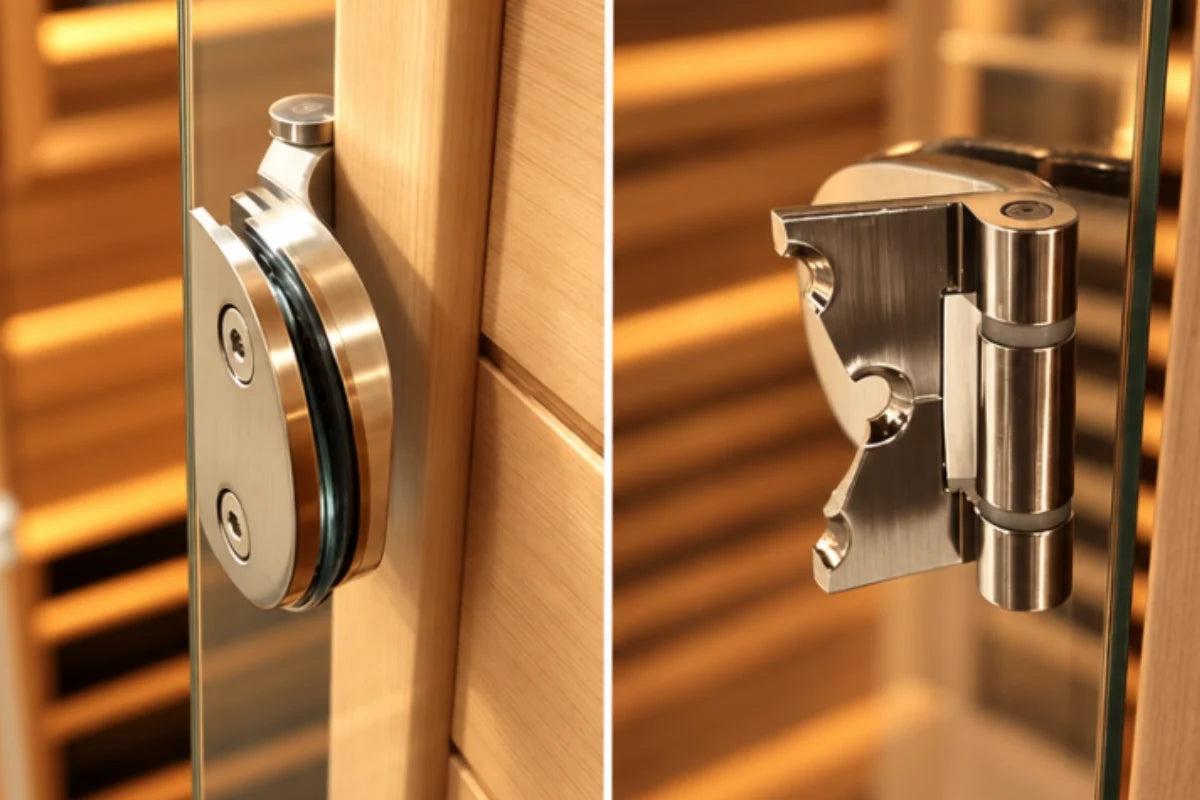
The glass clamps. These are the metal fittings that hold the tempered glass panel inside the door frame. Ours are deliberately heavier than what most competitors use, and the reason is mechanical rather than cosmetic: a clamp distributes pressure across the glass edge. Too little material and the pressure concentrates, the seal around the perimeter stops being even, and the door starts leaking heat exactly at chest and shin height.

Our own product copy puts it plainly: "Our improved clamps create a tighter seal around the glass door." That's not a slogan, it's the whole job. An evenly sealed perimeter is what makes the cabin warm the way the thermostat says it is.
And there's a reason this matters beyond temperature. A door that leaks at chest and shin level means you're warm at the back and cool at the front — which is the single most common reason people shift, rotate, and cut sessions short.
Stand outside any cabin and rest one finger against the door when it's open about two inches.Let go and push it closed gently.It should finish the last inch on its own.
Then run your fingertips slowly around the whole perimeter of the closed door and feel for a consistent seal — no soft spot, no place where air moves.
Finally, look at the clamps holding the glass. Thick and machined, or thin stamped metal? If the hardware looks like an afterthought, the seal usually is one too.
The Wood: Solid, or Something Wearing Solid's Clothes
Here's the most common trick in the category, and it's a quiet one.
A cabin can be described as "cedar," "hemlock," or "wood construction" and still have a core of engineered board — particleboard or MDF — with a thin real-wood veneer glued over the faces people see. On day one the difference is invisible. Over two or three years of heat cycling, it isn't.
Solid wood moves with temperature and moisture the way a living material does, and comes back. Veneer over board doesn't.
The veneer lifts at the seams first, usually near the door frame and the floor line, because those are the edges that see the widest swings. Once the panels warp, the seams open, and no amount of tightening brings a warped panel back into line.
Every cabin we build is solid wood throughout — no veneer over board, no engineered core. It's true of our entry models as much as our flagship ones;
it's simply how we build.
Where to look, because it's never on the front
Nobody photographs the back of a cabin, the underside of the floor, or the raw end grain at the door edge. Which is exactly why those are the places to inspect.
- The end grain. Find any cut edge — the door frame edge is easiest. Solid wood shows continuous grain right through the thickness of the board. A veneered panel shows a different material in the middle: a lighter, uniform layer with no grain running through it.
- The seam line on the inside face. Run a fingernail across the inside of a side wall. A veneer usually leaves a faint step or line where the sheet ends and the next one begins. Solid wood has no such line, because there's no sheet.
- The back panel and the floor. These are the faces no photo shows and no one checks. On a genuinely solid build they look like the front. On a veneered one, they're often the giveaway.
- The weight. This one you can feel before assembly. Solid wood panels are noticeably heavier to lift than the same-looking engineered ones. If a delivered crate seems suspiciously light for its size, weigh that observation.
Where the Wood Meets the Heat
This is the detail almost nobody talks about, and it's the one our own factory spends the most time on.
The heater panels don't float in the cabin. They're held in place by solid wood battens — the narrow timber strips that frame each panel and run between the slats.
Ours are fitted closely to the panel housings, with narrow, uniform gaps rather than the wide, uneven ones that come out of a loose assembly line.
You might reasonably ask why that's worth caring about. Three reasons, and they're all mechanical.
First, a closely fitted batten holds the panel flat and still. A panel held loosely is a panel that can bow slightly as it heats, and a bowed panel doesn't radiate evenly across its face.
Second, heat cycles make wood expand and contract. A tight, uniform gap gives that movement somewhere controlled to go.
A wide, sloppy gap doesn't, so the movement shows up somewhere else — as a rattle, a squeak, or a slat that starts working itself free at the seam.
Third, and most simply: the wood is what's holding your heater. If the fit is careless where it grips the panel, that's a structural margin you didn't get.
Twenty minutes into a hot session, listen. Then press a palm flat against a side wall and feel. A well-built cabin is quiet and still.
A loose one ticks and rattles as the panels and slats expand at different rates — and that noise is usually the first symptom of a batten fit that was never right.
If you're evaluating a display cabin, ask them to run it hot and stand inside it before you decide.
Count the Panels, Then Find the Cold Spot
Now the part that's actually visible, if you know what to count.
Most two-person infrared cabins have heaters on the back wall and the two side walls.
That's it. Heat comes at you from three directions, and the front is usually just glass — a cold pane against your chest, your knees, and your shins.
Our Maxwell-907BHN takes a different approach. It carries nine large carbon heating panels — more than any other indoor cabin we build — including coverage that most brands simply skip:
- A heater behind the front door glass. Most infrared sauna brands don't put a heater on the front door. Ours does, which is what closes the loop.
- Calf-level panels on both sides. Your lower legs are the part people notice getting cold in a three-sided cabin, and the part most builds ignore entirely.
- Foot-level heating along the floor run. Warm feet change the whole character of a session — it's the difference between sitting still and shifting around.
- Full 360-degree coverage on all four walls, so the front of your body is as warm as your back.
The result isn't just a hotter number on a thermometer. It's a cabin with no cool corner to retreat from, which is what lets you sit still for a full session instead of rotating to chase the heat.
This check works on any cabin, ours included, and takes two minutes. Get it fully hot, sit down, close the door, and pay attention to your body rather than the display.
Chest, shins, and the top of your head are the three places a low-panel-count cabin neglects.
If any of them registers cool air, you've found the design compromise — and you've found it before you paid for it, which is the entire point.
Sound: The Difference Between a Speaker and a Sound Field
Bluetooth audio is the feature most cabins list and few cabins actually deliver. A single small speaker mounted in a wooden box does produce sound. It's just thin, hollow and slightly tinny — the audio equivalent of a phone on a table.

Ours uses a properly tuned 3D sound field built around better-quality drivers, arranged so the audio fills the cabin evenly instead of firing at you from one corner.
The practical result is that you're not turning it up to hear it, which is exactly how cabin speakers get fatiguing.
It's also the detail our owners mention u,MNBVCXZ08/nprompted more than any specification we list.qweoiuytrewqZXKL;'
A short sentence, but a revealing one. Nobody writes that about a speaker they're tolerating.
The Light, and the One Question That Separates Real From Rented
Red light therapy is the most abused term in this entire market, and it's abused in a very specific way: the words appear without a number.
"Red light therapy" on a product page tells you essentially nothing, because red light spans a wide band and only a narrow set of wavelengths does what buyers are actually paying for.
Our upgraded cabins emit a precise blend of 660nm red light and 850nm near-infrared light — and the reason those two specific numbers matter is that they behave differently once they reach your body.
| Wavelength | What It Is | Where It Works |
|---|---|---|
| 660nm | Visible red light | Sits nearer the surface — the layer associated with skin tone and collagen |
| 850nm | Near-infrared light, invisible | Penetrates further, toward muscle and joint tissue beneath the skin |
| Both together | A precise, paired blend | Surface and depth in one session, working alongside the far-infrared heat rather than instead of it |
That pairing is the whole design. One wavelength alone covers half the depth. Two working together cover the range.
"What is the wavelength, in nanometers?"
A brand doing this properly will answer with two numbers, and probably a spec sheet. A brand that isn't will answer with a sentence about wellness, glow, and cellular energy.
This single question separates more real saunas from look-alikes than any other test in this article — because a wavelength is a verifiable fact, and marketing language is not.
If it's genuinely 660 and 850, saying so costs nothing.
The clear pair is standard across our red-light cabins, including the Maxwell-902BHN. And if you already own a sauna without it, we make a Red Light Therapy Expansion Kit that adds the same 660nm and 850nm pairing, so a red-light upgrade doesn't mean replacing the whole cabin.
The Whole Checklist, In One Place
If you take nothing else from this article, take this table. Every row is something you can verify with your own hands, on any sauna, before you spend anything.
| What's Claimed | How You Verify It |
|---|---|
| "Premium construction" | Find a cut edge. Look for continuous grain through the thickness. Veneer over board shows a different, grainless layer in the middle. |
| "Tight-sealing glass door" | Push the door closed from two inches away. It should finish on its own. Then run fingertips around the perimeter and feel for an even seal with no soft spot. |
| "Heavy-duty hardware" | Look at the metal clamps holding the glass. Thick and machined, or thin stamped metal? Weight is not a marketing claim — it's material. |
| "360-degree heating" | Count the panels. Then get it hot, sit inside, and find where your body feels cool. Chest, shins and the top of your head expose the gaps. |
| "No rattles or creaks" | Run it hot for twenty minutes, stand inside, and listen. Then press a palm against a side wall and feel for movement. |
| "Built to last" | Ask what the warranty actually covers, in years, part by part. Vague answers are their own answer. |
| "Red light therapy" | Ask for the wavelength in nanometers. Two numbers, or it isn't a specification. |
None of these tests require tools, expertise, or a showroom. They require about ten minutes and a willingness to put your hands on something before you pay for it.
The Bottom Line
The infrared sauna market in the US has grown fast enough that a lot of listings now look the same from the outside — same photography, same vocabulary, same claims.
That's not a reason to distrust every brand. It's a reason to stop shopping with your eyes.
Components are where a build tells the truth: a catch that finishes the door, clamps with enough metal in them to hold a seal, solid wood through the whole panel instead of a veneer over board, battens fitted close enough that nothing rattles, nine panels instead of five, a wavelength printed in nanometers instead of described in adjectives.
Every one of those can be checked. We'd rather you checked ours than trusted our copy — and if you check a competitor's first, that's genuinely fine with us, because a buyer who knows how to look is a buyer who ends up happy either way.
Once the build is settled, the next question is usually how long a session should run — our guide to how long to stay in an infrared sauna covers that in detail.
Frequently Asked Questions
How can I tell if a sauna is solid wood or veneer?
Find a cut edge — the door frame edge is easiest — and look for continuous grain running through the full thickness of the board. Solid wood shows it. Veneer over particleboard or MDF shows a different, grainless material in the middle, and often a faint seam line on the inside face where the sheet ends.
Does the thickness of the glass clamps actually matter?
Yes, mechanically. The clamp distributes pressure along the glass edge and holds the panel in the frame. Thinner hardware concentrates that pressure, the perimeter seal becomes uneven, and the door leaks heat — most noticeably at chest and shin height, which is exactly where people feel cold first.
Why does panel count matter so much?
Because heat coming from three sides leaves the front of your body cold against the glass door. More panels, including a heater behind the front door glass and calf-level panels on both sides, mean the warmth surrounds you evenly instead of leaving a cool spot to sit against.
What wavelengths should a sauna's red light be?
A 660nm and 850nm pairing is the standard for cabins doing this properly. The two operate at different depths — 660nm nearer the surface, 850nm penetrating further toward muscle and joint tissue — and together they cover a range neither manages alone. If a listing says "red light therapy" without naming wavelengths, that's the answer you got.
Can I add red light therapy to a sauna I already own?
Often, yes. A Red Light Therapy Expansion Kit adds the same 660nm and 850nm pairing to an existing cabin, which means an upgrade doesn't have to mean replacing a sauna that's otherwise working well for you. Check compatibility with your model first.
Is Bluetooth audio in a sauna actually any good?
It depends entirely on the speaker and the tuning. A single small driver in a wooden box sounds thin and needs to be turned up, which gets tiring fast. A properly arranged multi-driver setup fills the cabin evenly at low volume. Owners mention good cabin audio far more often than any spec sheet feature.
How long does an infrared sauna take to heat up?
Roughly 20 to 30 minutes from cold, depending on ambient temperature and whether the cabin is indoors or outside. A cabin with a leaky door seal or fewer panels will take longer to reach temperature and will struggle to hold it — another reason the door hardware matters more than it looks like it should.
What should I look at first when comparing two similar saunas?
The door, then the wood, then the panel count. Those three reveal more in ten minutes than any comparison of marketing copy. Start with a cut edge and a closed door, and work outward from there.
How much maintenance do solid wood panels need?
Less than engineered board, because solid wood tolerates heat and humidity cycling without delaminating. In practice, the maintenance is mostly habits: air the cabin out with the door open for ten minutes after a session, wipe condensation from the glass, and keep the interior dry. The wood largely looks after itself.
We've been building saunas since 2004, and we've watched this market fill up with cabins that photograph beautifully and shortcut everything you can't see. So we've gone the other way on purpose: heavier clamps than the category uses, solid wood through every panel, battens fitted close to the heater housings, nine panels where most builds use five, and a red-light blend specified in nanometers rather than adjectives.
Because we sell factory-direct, that lands at $1,999 for the Purity-902CH rather than a showroom price, backed by a two-year warranty on heaters and electrical and one year on the wood, with optional extensions available. Browse the full range at salusheat.com/collections/all-products.
- Clamps heavier than the category standard, for an even seal around the glass
- Solid wood throughout every panel — no veneer over board
- Solid wood battens fitted closely to each heater housing
- Nine large carbon panels on the 902CH, including a heater behind the front door glass and calf-level panels on both sides
- A tuned 3D sound field built around better-quality drivers
- A precise 660nm and 850nm red-light blend on our red-light cabins
- Two-year warranty on heaters and electrical, one year on the wood, optional extensions
The parts you can't see are the parts we spend the money on. That's the whole pitch, and every one of them is something you can check with your own hands.
And if you're still shopping, which of these checks are you going to run first? Share it in the comments. Somewhere out there, someone is comparing two listings that look identical, and this is exactly the kind of detail they're missing.
This article is for informational purposes only and does not constitute medical advice. Red light and infrared therapy are wellness modalities, not treatments for medical conditions; consult a physician regarding any health concern. Product specifications, panel configurations, and available upgrades vary by model and should be confirmed on the individual product page before purchase.
