
What Is Chromotherapy: Color Light Therapy Benefits
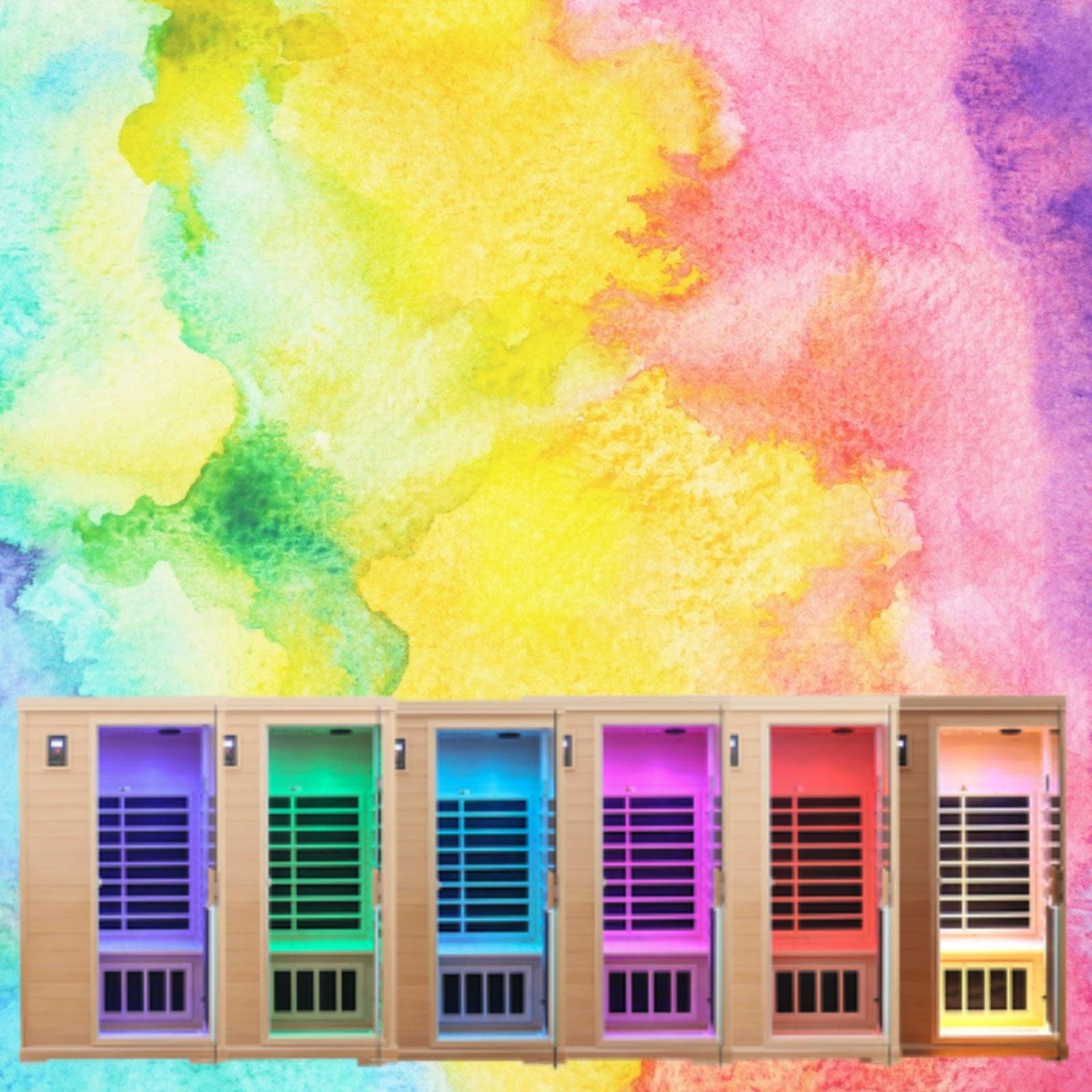
A clear, evidence-based look at chromotherapy — and what it actually means for the experience of using an infrared sauna at home.
At SalusHEAT, our infrared saunas are designed primarily for recovery. But they also offer a secondary feature that has been getting more attention lately: chromotherapy — the use of visible color light alongside infrared heat.
There is a lot of confusion about what chromotherapy actually is. Some sources treat it as established medicine. Others dismiss it as pseudoscience. The truth, as usual, is more nuanced than either framing.
This article is meant to address some of the most common questions we hear about chromotherapy — what it is, where the scientific research actually stands, and what role it plays in an infrared sauna session.
What Is Chromotherapy?
Chromotherapy — sometimes called light therapy — is the application of visible light (the color spectrum) to support tissue regeneration and healing.
Light is electromagnetic radiation. Each color in the visible spectrum has a unique wavelength, and those wavelengths interact with the body in different ways.
The underlying theory is that each color carries a specific frequency of vibration, and that imbalances in the body's energy systems — physical, emotional, mental, or otherwise — can show up as illness or discomfort. Color light, in this framing, is a way to bring those systems back into balance.
It is worth being clear about the term itself. "Chromotherapy," "light therapy," and "color therapy" are often used interchangeably, which causes a lot of confusion. Light therapy and chromotherapy refer to the direct application of light to the body. Color therapy, by contrast, usually refers to the design of physical spaces — hospitals, schools, offices — and is a different conversation entirely.
The most useful framing of chromotherapy is neither miracle cure nor empty ritual. It is a well-defined set of light-based practices, some of which the body of research supports more strongly than others.
Is Chromotherapy Just "New Age" Pseudoscience?
It is a fair question, and one worth taking seriously.
The honest answer is: chromotherapy has a longer and more scientifically grounded history than most people realize.
Light has been used therapeutically for more than a century. The use of blue light to treat infant jaundice, for example, dates back to the 1950s and remains standard practice in neonatal care today.
Doctors began using white and blue light therapy for Seasonal Affective Disorder (SAD) in the 1980s. Light-based treatments for skin conditions go back even further, to the early 1900s.
The FDA has already approved light therapy for several specific uses, including:
- acne
- anti-aging — including collagen production and wrinkle reduction
- hair loss prevention and hair regrowth
- pain relief
- fat loss
- stem cell production
Current research and clinical trials are also exploring light therapy for a much wider set of conditions, including:
- Alzheimer's disease
- Parkinson's disease
- traumatic brain injury (TBI)
- stroke
- heart attack
- spinal cord injuries and nerve regeneration
None of this means that every claimed use of color light is well supported. It does mean that the underlying mechanism — light interacting with the body in measurable ways — is real, and has been for a long time.
How Do The Various Colors Affect The Body?
The most common version of chromotherapy assigns each color of the visible spectrum a particular set of associations. The research behind some of these is stronger than others, but as a starting framework, the seven-color model is the one most chromotherapy practice is built on.
Red
Red light is associated with activation of the circulatory and nervous systems. It is often linked to red blood cell production, collagen production, and supporting the body's natural fat-burning processes.
Orange
Orange light is generally associated with mood. It is also frequently referenced in connection with stomach and digestive issues, and with respiratory conditions such as asthma and bronchitis.
Yellow
Yellow light is associated with internal tissues, and is often described as reactivating and purifying the skin.
Green
Green light is calming and relaxing. It is frequently used in combination with blue light in light-therapy protocols for Seasonal Affective Disorder.
Blue
Blue light is associated with muscle and skin cell stimulation. It is also the color most studied in clinical settings — most notably for treating neonatal jaundice, where it helps break down excess bilirubin in an infant's liver.
Purple
Purple light is associated with the nerves and the lymphatic system. It is frequently referenced in connection with inflammation, urinary conditions, and certain eye-related issues including glaucoma and eye fatigue.
Each of these color associations is a starting point rather than a hard rule. The strength of the research varies considerably by condition, and the experience of using a specific color during a sauna session is shaped by both the color itself and the broader context of the session — the heat, the stillness, the time of day.
The seven colors are best understood as a vocabulary, not a prescription. The value comes from how intentionally they are used, not from any single color's supposed effect.
How much of chromotherapy's effect is the light itself — and how much is the calm, screen-free moment it creates?
Chromotherapy In The SalusHEAT Sauna
In a SalusHEAT infrared sauna, chromotherapy is built in as a complementary feature.
The primary experience is always the infrared heat and the quiet of the session — the color is there to enhance that experience, not to replace it.
Most users settle on one or two colors that they associate with a particular kind of session.
Red and orange tend to show up in the morning, when the goal is energy.
Greens and blues tend to show up in the evening, when the goal is calm.
There is no single right way to use it. Like the rest of the sauna experience, the value of chromotherapy is shaped less by the specific color chosen and more by the consistency with which the practice becomes part of a routine.
Key Insight
Chromotherapy is not a single thing. It is a category that includes well-established medical uses of light — like blue light for neonatal jaundice and white light for Seasonal Affective Disorder — alongside more exploratory uses that are still being studied.
The FDA has already approved light therapy for several specific conditions, including acne, hair loss, pain relief, and anti-aging. Other uses — for Alzheimer's, Parkinson's, stroke recovery, and similar — remain areas of active research.
In an at-home infrared sauna, chromotherapy is best understood as a complementary feature. It is not a substitute for medical treatment, but it is a meaningful addition to the broader wellness experience the sauna provides.
Frequently Asked Questions
Is chromotherapy the same as light therapy?
In practice, the two terms are often used interchangeably. The clearer distinction is between light therapy (direct application of light to the body) and color therapy (the design of physical spaces).
Is chromotherapy scientifically supported?
Some uses of light therapy are very well established — including blue light for neonatal jaundice and light therapy for Seasonal Affective Disorder.
Does chromotherapy actually work?
The honest answer is: it depends on the condition and the protocol. For the conditions where light therapy is well studied, yes.
For broader wellness claims, the evidence is still developing — and chromotherapy is best treated as a complement to other healthy habits rather than a standalone solution.
What colors are available in a SalusHEAT sauna?
SalusHEAT infrared saunas with chromotherapy offer the full seven-color spectrum — red, orange, yellow, green, blue, purple, and white — with simple in-sauna controls to switch between them during a session.
Should I use chromotherapy in every sauna session?
There is no single right answer. Some users prefer one consistent color; others rotate based on the time of day or how they want the session to feel. Like the rest of the sauna experience, what matters most is the routine you can actually sustain.
The best wellness practices are the ones that earn their place in the routine — and stay there, session after session.
