
Does Sauna Improve Workout Performance?
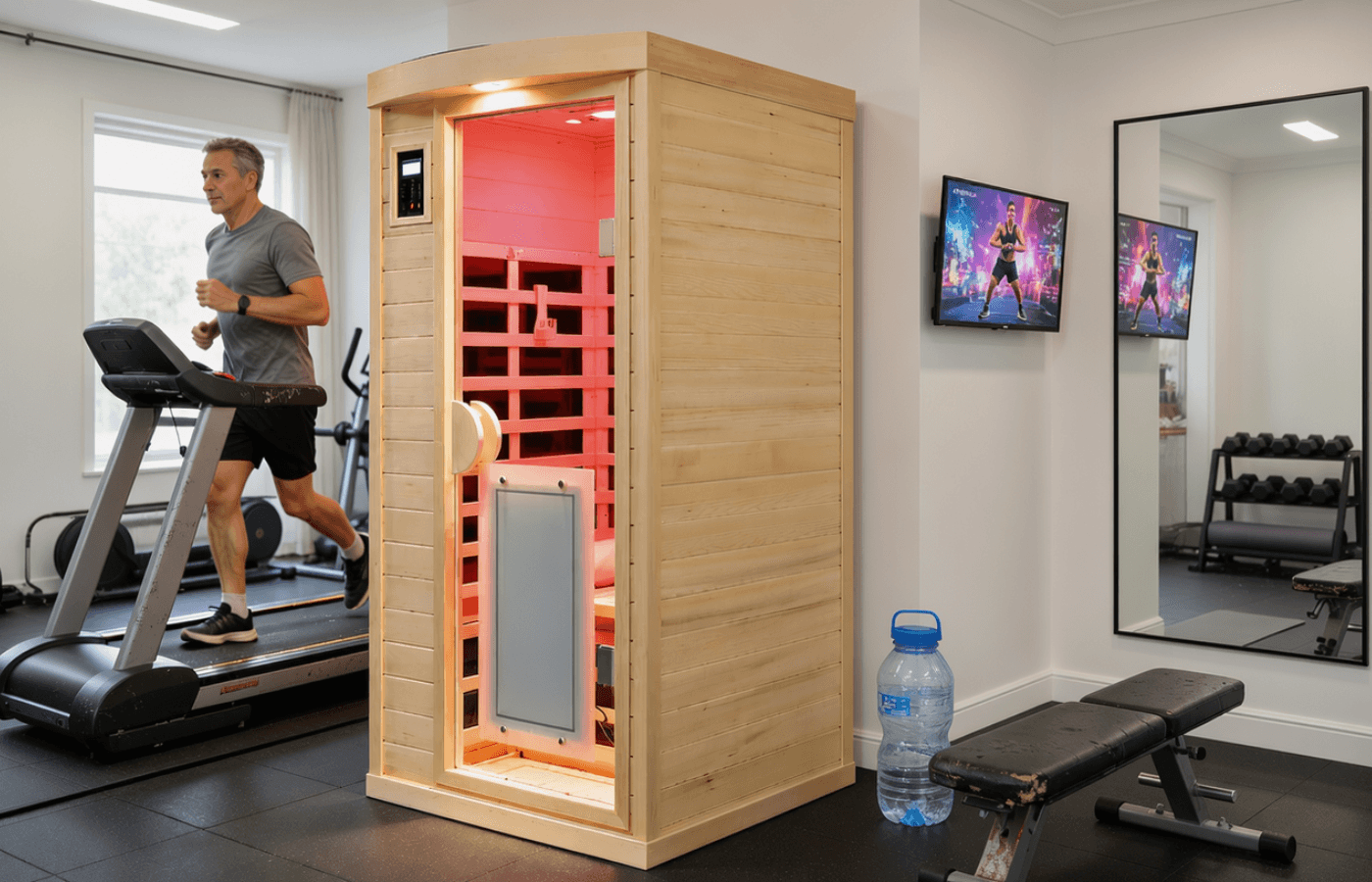
Yes — But Only If You Stop Using It Wrong
A running friend of mine used to finish track sessions, hop in the car, drive home, shower, sit on the couch. Two years ago he started walking into a sauna at the gym instead of straight to the showers. Same workouts. Same sleep. Same everything else.
Half a season later, his 10K time dropped by almost a minute. His coach called it “aerobic gains.” His wife called it stubbornness. Honestly, it was the sauna.
So — does sauna actually improve workout performance? It can. It really can. But only if you stop treating it like a reward at the end and start treating it like another rep in the workout. This post is the version of that conversation I wish I had with him two years ago, before he wasted a season figuring it out by trial and error.
The one-line version: post-workout sauna — three times a week, about 30 minutes each, for at least three weeks — will give you real performance gains. Most of those gains come from your heart and your blood, not your muscles.
If that already feels like a lot of structure, hang in there. There is a simpler way to think about it once you see why it works.
The One Study Every Athlete Ends Up Reading
There is a 2007 study from the University of Otago, run by a researcher named Scoon, that almost every serious athlete stumbles into eventually. It is short, it is clean, and the numbers are the kind that make you stand up a little straighter when you read them.
A group of competitive male runners kept their normal training. Half of them added 30-minute sauna sessions after workouts, about three times a week, for three weeks. The other half did the same workouts and skipped the sauna.
What happened:
- The sauna group could hold a hard treadmill run 32% longer before quitting.
- Their blood plasma — the fluid part of blood that carries oxygen — expanded by about 7%.
- Their VO2-related endurance markers improved by roughly 1.9%.
If 1.9% sounds small, it is not. Most trained runners spend an entire season trying to claw out a 1% gain. The “always on, always adapting” feeling athletes get from a sauna comes from exactly this kind of upgrade.
Why this matters for you. The runners were not training harder. They just recovered better between sessions and their bodies stopped slowing them down. Same input, more output. That is the whole game.
What the Sauna Is Actually Doing to Your Body
There is no single magic switch. There are five small switches that all move at once when you sit in enough heat, often enough.
| Mechanism | What changes | What the athlete feels |
|---|---|---|
| Plasma volume expansion | +5–7% blood plasma in roughly three weeks | More gas in the tank on long efforts |
| Heat shock proteins (HSPs) | Cellular repair crews switch on | Less next-day soreness, faster structural recovery |
| Growth hormone | Short, sharp spike right after the session | Better tissue repair when paired with sleep |
| Thermoregulation | Sweating starts earlier, lasts longer | Cooling is more efficient in heat |
| Between-session recovery | Perceived soreness, fatigue drop | Stacking more quality sessions week on week |
The dominant one is plasma volume. That is the lever the Scoon numbers point at. The others are smaller individually and large collectively, which is why consistency — not intensity — is what the studies are really measuring.
1. Your blood quietly gets bigger
Heat tells your body to hold onto fluid and make more plasma — the liquid part of blood that ferries oxygen around. More plasma, more oxygen per heartbeat, more gas in the tank on the back half of a long effort. This is the biggest single reason the Scoon numbers exist.
2. Your cells send in the cleanup crew
Heat also turns on heat shock proteins, which sound dramatic but really just mean “tiny repair crews that show up when your muscles are stressed.” They patch up the small damage from a hard session so you walk into the next one in better shape than you deserve to be.
3. Growth hormone pokes its head up
Several studies show a real spike in growth hormone right after sauna. It is short and modest in real-world training, but if you treat the sauna like a recovery tool that pairs with sleep, the hormone adds up over a season.
4. Your body remembers how to sweat
Sauna regulars start sweating earlier and sweat more. For anyone training for a summer race, a half marathon, a long gravel ride — anything outdoors in the heat — this is a quiet superpower. You stop overheating before it costs you the next mile.
5. You feel less destroyed the next morning
This is the boring one and it is the one athletes actually feel. Less soreness, less “do I really need to do this again today,” more consistent weeks. Consistency is how PRs are made.
Before or After a Workout — Pick One
People overthink this. Here is the simple version.
After is where the research lives. Almost every positive study used post-workout sauna. Your body is already warm, your heart is already elevated, and the plasma-volume effect tends to happen in this window.
Before is mostly a warm-up. A quick, mild sauna before an easy session can loosen you up. But before a hard one — intervals, heavy squats, anything where you need fresh legs — it just pre-fats your cardiovascular system and quietly steals from the workout itself.
If you can only do it once, do it after. Save before-sauna for days when everything else is easy.
If your gym only has a sauna before the workout floor opens (early-bird crowd), do it then — it is still useful. Just keep it short, keep it easy, and do not stack it in front of an interval session.
A Routine You Can Copy Tonight
This is the cleanest version of what the Scoon protocol looks like in real life. Print it, screenshot it, stick it on the fridge — whatever works.
3 times a week. Pick the same days each week. Consistency beats volume every time.
30 minutes per session. Start with 15 if you are new, climb up.
Within about 30 minutes of finishing your workout. The closer to the workout the better.
Temperature: roughly 80–100 °C (176–212 °F) for a traditional Finnish sauna, or 50–65 °C (122–150 °F) for infrared.
Drink about 500–750 ml of water before you go in. Another 500 ml after.
Cool down for 10–15 minutes at room temperature afterward. Do not walk straight into an ice bath.
Stick with it for at least three weeks. That is when the real numbers show up.
That is the whole routine. Ten minutes of thinking plus 40 minutes of sitting. Most gyms already have everything you need for it.
A quick comparison
| Question | Traditional sauna | Infrared sauna |
|---|---|---|
| Air temperature | 80–100 °C | 50–65 °C |
| How heat reaches you | Hot air, dry | Direct radiant heat through the body |
| Evidence for endurance | Highest (most studies) | Growing, comparable for recovery |
| Best fit if | Your gym has one, you want the original protocol | You want it at home, the air heat is too much |
| The protocol | 3x / week, 30 min, after workouts | 3x / week, 30 min, after workouts |
The mechanism does not care which box you sit in. Three times a week, 30 minutes, after workouts. That part does not move.
The Seven Things Athletes Get Wrong
After watching hundreds of people try sauna for performance, I notice the same handful of mistakes over and over. None of them are dramatic. They are all easy to fix.
- Going too long on day one. Twenty minutes in a 95-degree room sounds easy until you stand up. Start with 10–15. Build up over two weeks.
- Hydrating after, not before. By the time your mouth is dry, you are already behind. Front-load your water.
- Pairing sauna and ice bath back-to-back. Doing both inside an hour mostly cancels each other out. Keep at least 4–6 hours between them, ideally on different days.
- Drinking in the sauna. Skip it. Hydrate before, after, between rounds — never during.
- Treating it as a reward, not a tool. The day you start skipping sauna because “you do not feel like it” is the day it stops working. Show up on the boring days, especially the boring days.
- Doing it before a hard session. Save before-sauna for easy days. Otherwise it costs you the workout.
- Quitting after two weeks. Two weeks feels better. Three weeks is where you can actually see it on a stopwatch. Give it the third week before deciding.
The single most useful habit is treating the sauna like training itself. It is on the schedule. It happens on the boring days. It does not get skipped because you “feel tired” — the tiredness is exactly when it works best.
Sauna or Ice Bath — Which One
They are not rivals, they are different tools.
| Time horizon | Sauna delivers | Ice bath delivers |
|---|---|---|
| Within 2 hours | Mild calm, lower perceived fatigue | Strong drop in muscle soreness |
| Within 24 hours | Lower DOMS, better sleep onset | Continued soreness relief |
| Within 3 weeks | Cardio, plasma volume, VO2 improvements | Diminishing returns if used too often |
| Long term | Heat acclimation, recovery base | Risk of blunting muscle adaptation |
If you can only fit one and your goal is performance, sauna has the stronger evidence base. If you can fit both, separate them by at least four hours. The Finnish training literature is also clear that stacking cold immediately after heat blunts the heat adaptations.
When To Skip the Sauna Entirely
Skip sauna entirely for any of the following. None of these are about sauna being dangerous — they are about not stacking heat stress on top of a system that already has enough on its plate.
- Uncontrolled high blood pressure or any active heart condition
- Pregnancy
- Active illness — fever, flu, anything with chills
- Significant alcohol use in the last 12 hours
- Serious dehydration earlier in the day
For the longer list of edge cases — kids, older adults, medications, recent surgery — check with a physician first, and review our complete sauna safety guide for scenario-by-scenario details.
The performance story is the same story we keep coming back to across the sauna literature: a small change in recovery, repeated often, compounds into a noticeable change in output over weeks. The sauna is the support step. The training is the work. The routine is what makes the difference.
What that means in product terms:
- Ultra-low EMF engineering for clean, predictable sessions you can do most days of the week
- Full-spectrum infrared for even, predictable heat at a comfortable home temperature
- Comfortable temperature range for the 20–30 minute protocols used in the studies
- Easy-exit design so the post-session cool-down — and the next morning — actually happen
- Factory-direct pricing for long-term ownership, because the routine only works if the sauna stays in the house
If you are working out five days a week and want the recovery step to be as automatic as the warm-up, an infrared sauna at home is the simplest way to make this stick — same core mechanisms, lower heat, available in your slippers. If you are sizing your first one, our infrared sauna buying guide walks through the spec sheet without the marketing fog.
Frequently Asked Questions
Does sauna help build muscle?
Not directly. Sauna helps you train again tomorrow, with less breakdown. That is where the muscle comes from — more good sessions, not the sauna directly. Skip this if you only care about looking bigger; keep it if you care about actually training for months on end without getting hurt.
Should I use the sauna on rest days?
Yes — especially during heat acclimation blocks. Rest-day sauna preserves the cardiovascular and plasma-volume adaptations without piling on more training load. Most pros put two easy days and one heavier day inside their weekly sauna rotation.
Is infrared sauna as effective as traditional sauna for performance?
For most of what people use saunas for — recover faster, sleep better, bounce back the next morning — infrared is more than enough. For pure endurance numbers, traditional sauna still has the most research behind it, but the gap is shrinking every year.
How long until I notice results from using a sauna after workouts?
You will probably notice the recovery feeling within the first week. Real performance numbers — faster splits, longer time to exhaustion — take three to four weeks of steady sessions to show up. Treat the sauna like a new block of training: it is a long-game thing.
Can I use the sauna during marathon or competition training?
Yes. Heat acclimation is one of the few real, well-studied performance edges for endurance athletes when a race is likely to be warm. Space your sauna days away from your hardest track sessions, and let the sauna do its work on the easier days.
Sauna or ice bath — which is better for workout performance?
Different tools. Sauna is what trains your heart, blood, and thermostat over weeks. Ice bath is what calms down soreness in the next two hours. If your goal is performance, the current evidence leans toward sauna. If you can fit both, keep four to six hours between them.
What is the best sauna protocol for workout performance?
Three times a week, roughly 30 minutes, after your workouts, for at least three weeks. That is the whole thing. Roughly 80–100 °C for traditional, 50–65 °C for infrared. Water before, cool down after. Most gyms already have everything you need to start tonight.
References
- Scoon GSM, et al. Effect of post-exercise sauna bathing on the endurance performance of competitive male runners. Journal of Science and Medicine in Sport, 2007. PubMed
- Lee E, et al. Effects of regular sauna bathing in conjunction with exercise on cardiovascular function: a systematic review. 2022. PMC
- Ahokas EK, et al. Effects of repeated use of post-exercise infrared sauna on neuromuscular performance. 2025. PMC
- Laukkanen JA, et al. Cardiovascular and other health benefits of sauna bathing. Mayo Clinic Proceedings, 2018. PubMed
Questions? Real humans at help@salusheat.com.
